
Here's the conversation we have at our Fort Myers showroom at least three times a week:
"We want a fishing boat. But my wife wants something comfortable. And we've got two kids under ten. Oh, and we want to go to Cayo Costa on weekends. And maybe run offshore when the weather's good."
That's not one boat. That's the center console vs. dual console debate in a nutshell. And in Southwest Florida, where the same boat needs to handle Pine Island Sound flats, Gulf of Mexico chop, sandbar anchoring, and a 30-mile offshore run, the choice matters more than it does anywhere else in the country.
The short answer? If fishing is the priority and everything else is secondary, get a center console. If the family experience matters as much as the fishing, get a dual console. But that's a bumper sticker, not a guide. The real answer depends on how you actually use a boat in SWFL waters, and that's what we're going to walk through.
We sell both layouts across all our brands at Fish Tale Boats. Grady-White makes some of the best center consoles and dual consoles on the water. Robalo builds both in every size class. We have no reason to push you toward one over the other. The right answer is the one that matches your life.
What's the Actual Difference?
If you're new to boating, the layout distinction is simple.
A center console has a single helm station positioned in the middle of the boat. The deck wraps around it on all sides, giving you open walkways from bow to stern. There's no windshield, no enclosed bow area, and no passenger-side console. It's an open platform designed for maximum deck space and 360-degree access.
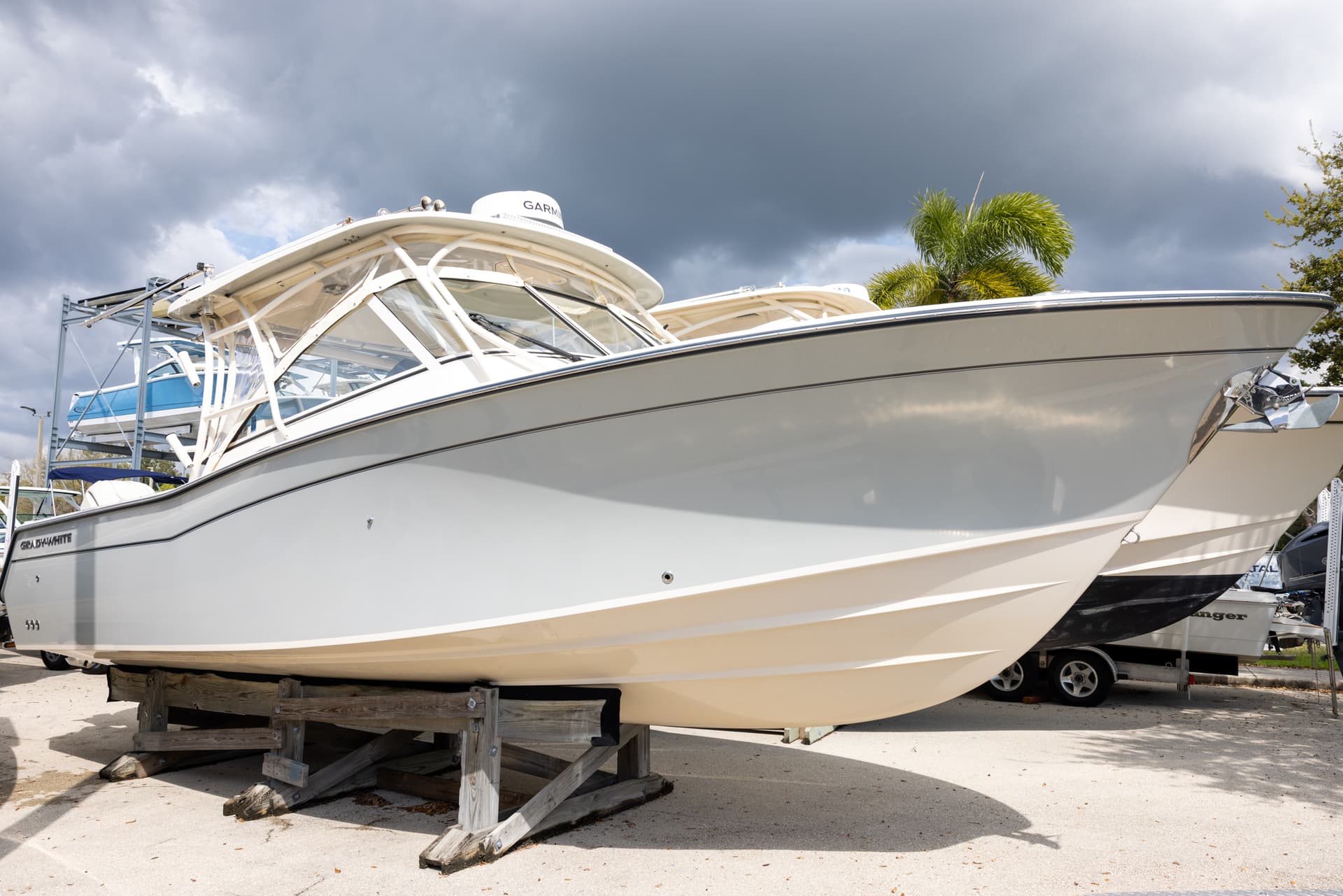
A dual console splits the helm into two consoles, one on the port (left) side and one on the starboard (right). A full windshield connects them, creating an enclosed forward area with a walkthrough to the bow. The passenger side typically has a dashboard, grab handles, and sometimes a glove box. The result is a more car-like layout with a protected cockpit.
Both designs share the same hull underneath. A Grady-White Canyon 306 (center console) and a Grady-White Freedom 285 (dual console) both ride on the SeaV2 hull. The difference is what's built on top of that hull.
Center Console: The Fishing Machine
Why Anglers Love Center Consoles
The center console exists because of fishing. Every design decision serves the angler.
360-degree fishability: You can fight a fish around the entire boat without stepping over consoles, windshields, or passenger seats. When a 40-pound kingfish takes you from the stern to the bow and back, you need clear walkways. A center console gives you that.
Maximum deck space: Without a second console and windshield eating up room, you get more usable cockpit area. That means bigger fish boxes, more rod holders, larger livewells, and more room to move when multiple people are fishing simultaneously.
Visibility: The elevated helm position in the center of the boat gives the captain clear sightlines in every direction. In Southwest Florida, where you're constantly watching for crab trap buoys, shallow water, and other boats in the passes, visibility matters.
Easier to rig and customize: The open layout makes it simple to add custom rod holders, outriggers, T-top accessories, and aftermarket electronics. Center consoles are modular by nature.
The Trade-offs
Let's be honest about what you give up.
No wind protection: There's no windshield. On a cool January morning running across Charlotte Harbor at 30 knots, you and everyone on board are in the wind. In summer, that's fine. In the SWFL "winter" (yes, it gets into the 50s), it's uncomfortable.
Less comfortable for passengers: The people not driving are typically standing, sitting on a leaning post, or perched on a forward casting platform. It's fine for a fishing crew. It's less fine for your spouse and a couple of kids on a four-hour trip to Keewaydin Island.
Limited head facilities: Most center consoles under 27 feet have a porta-potty tucked under the console. It works, but it's not the enclosed head with a door that your family is going to appreciate on an all-day trip.
Sun exposure: Without an enclosed bow or cabin, everyone on board is in the sun all day. A T-top helps at the helm, but passengers in the bow are fully exposed.
Best Center Consoles for Southwest Florida
Grady-White Canyon 306: The offshore king. SeaV2 hull, massive fish boxes, livewells designed for long offshore transits. If you're running to the Mohawk wreck or the Blue Hole and back, this is the boat. The continuously variable deadrise gives you a soft ride through Gulf chop that most boats in this class can't match.
Robalo R270 / R277: The SWFL workhorse. Hydro Lift hull gets on plane fast under load, Kevlar-reinforced keel handles the shallow passes, and the high freeboard keeps the cockpit dry. Twin engine options and 50-gallon integrated fish boxes make it a serious offshore platform at a more accessible price point than the Grady-White.
Robalo 246 Cayman: Not technically a center console (it's a bay boat), but worth mentioning because it's one of the most popular boats in Southwest Florida. The 16-inch draft lets you run Pine Island Sound and the Ten Thousand Islands, and the Hydro Lift hull handles nearshore offshore runs on calm days. If your fishing is mostly inshore with occasional 9-mile reef trips, the Cayman is hard to beat.
Dual Console: The Do-Everything Boat
Why Families Love Dual Consoles
The dual console was designed for the buyer who wants one boat that does everything reasonably well instead of one thing perfectly.
Wind and spray protection: The full windshield and enclosed bow area block wind, spray, and rain. Running across the Gulf on a 3-foot chop day, the difference in comfort between a center console and a dual console is dramatic. Your passengers arrive dry. Your kids aren't crying about the spray. Your spouse actually wants to come back next weekend.
Comfortable seating: Dual consoles have real seats. Not leaning posts. Not cooler cushions. Actual seats with backrests, often with flip-up bolsters that let you sit or stand at the helm. The bow area typically has wraparound seating that works for lounging at the sandbar or accommodating a full crew.
Enclosed head: Most dual consoles 24 feet and up include a real head compartment with a door, often tucked into the port console or accessible through the bow walkthrough. For families, this is non-negotiable. The Grady-White Freedom 285 has a fully enclosed head with a sink and a vent, and it's a game-changer for all-day trips.
Versatile layout: Dual consoles transition between fishing mode and cruising mode. Fold down the transom seats, break out the rods, and you've got a capable fishing platform. Fold them back up, throw down some towels in the bow, and you're set for Cayo Costa.
The Trade-offs
Less deck space for fishing: The second console and windshield take up room that would otherwise be open deck. You lose walkway width on the port side and some of the bow deck space. It's still fishable, but you won't have the 360-degree freedom of a center console.
Slightly harder to rig: The windshield and console layout limit where you can mount rod holders and outriggers. You'll work around the structure rather than having a blank canvas.
Forward visibility in rough water: The windshield can develop salt spray and reduce visibility in heavy chop. Center consoles don't have this problem because there's nothing between you and the horizon.
Weight and cost: A dual console typically weighs 200-500 pounds more than a comparable center console of the same length, and costs slightly more. The additional structure, windshield, seating, and head compartment add up.
Best Dual Consoles for Southwest Florida
Grady-White Freedom 275 / 285: The gold standard. Same SeaV2 hull as the Canyon series, so the offshore ride is identical. The Freedom 285 adds a wide beam, port-side cockpit door (huge for landing fish or stepping off at a sandbar), enclosed head with a sink, and seating for 10+. This boat fishes the 30-mile reefs on Saturday morning and cruises to Keewaydin on Sunday afternoon without compromising either experience.
Robalo R247 / R257: Robalo's dual consoles give you the Hydro Lift hull performance with a family-friendly layout. The foldaway transom seating converts from a fishing cockpit to a social layout in seconds. High freeboard keeps the cockpit dry, and the Kevlar keel handles SWFL's shallow passes.
Chaparral 280 OSX / 310 OSX: If cruising and comfort are the priority with occasional fishing, the Chaparral OSX line is the luxury play. The 310 OSX features a wet bar with refrigerator, day cabin with electric head, dual Simrad displays, and Yamaha Helm Master for fingertip docking. The Extended V-Plane hull with 22 degrees of deadrise handles Gulf chop with a soft ride. These boats are built for the Southwest Florida lifestyle: sandbars, island hopping, sunset cruises, and the occasional reef fishing trip.
The SWFL Decision Framework
Forget the generic "center console for fishing, dual console for family" advice. In Southwest Florida, the decision is more nuanced because of how we use boats here.
Get a Center Console If...
- Fishing is why you own a boat. You're on the water primarily to catch fish, and everything else is a bonus.
- You fish offshore regularly. The open deck space, 360-degree access, and rigging flexibility matter more the farther offshore you go.
- You boat with other anglers. When your typical crew is 2-4 adults who all want to fish, a center console gives everyone room.
- You don't mind the trade-offs. You're fine with no windshield, minimal head facilities, and sun exposure. Or you're adding a T-top with enclosures aftermarket.
- You value simplicity. Center consoles are lighter, easier to trailer, and easier to wash down.
Get a Dual Console If...
- Your spouse and kids come along most trips. This is the number one reason people choose dual consoles. If the family is on board regularly, comfort isn't a luxury. It's what makes boat ownership sustainable.
- You mix fishing with cruising. Monday evening you run the passes for snook. Saturday you take the family to Cayo Costa. Sunday you anchor at the Sanibel sandbar. A dual console does all of that.
- Weather protection matters to you. If you boat through the cooler months (November through March), the windshield and enclosed bow make a noticeable difference, especially for passengers.
- You need a real head compartment. For trips over 3-4 hours, or any trip with kids, an enclosed head is close to essential.
- You want one boat to do it all. The dual console is the Swiss Army knife of Southwest Florida boating.
The "80/20" Rule
Here's how we frame it for customers who are truly stuck: think about what you do 80% of the time.
If 80% of your time on the water involves fishing, with the occasional family trip thrown in, the center console is your boat. Your family can come along on a center console. It's just not as comfortable as a dual console.
If 80% of your time is family cruising, sandbar days, and island hopping, with fishing mixed in when the opportunity arises, the dual console is your boat. You can absolutely fish from a dual console. It's just not as pure a fishing platform as a center console.
Carlos and Maria, who bought a Grady-White Freedom 275 from us last spring, are the perfect example. Carlos fishes the offshore reefs every other weekend. Maria and the kids come along once a month for Cayo Costa trips. Carlos originally wanted a Canyon 306. Maria wanted a Chaparral OSX. The Freedom split the difference perfectly. Carlos gets the SeaV2 offshore ride and enough deck space to fish seriously. Maria gets a windshield, comfortable seats, and an enclosed head. Both are happy. That's the dual console doing what it does best.
Size Matters: How Big Should You Go?
In SWFL, the size of your boat determines where you can go and what you can do.
20-24 Feet
Center console (e.g., Robalo R230): Great for bay fishing, nearshore reefs, and the ICW. You can reach the 9-mile reefs on calm days, but you're weather-limited for longer offshore runs. These boats are nimble, easy to trailer, and affordable to run.
Dual console (e.g., Robalo R207): Perfect for bay cruising, sandbar trips, and inshore fishing. The smaller dual consoles are ideal for families who boat mostly in protected waters like Estero Bay and Pine Island Sound.
25-28 Feet
Center console (e.g., Robalo R270, Grady-White Fisherman 257): This is the sweet spot for SWFL offshore fishing. Twin engines, enough fuel for 30+ mile runs, and the hull size to handle 3-4 foot Gulf chop. Most serious SWFL anglers land in this range.
Dual console (e.g., Robalo R247, Grady-White Freedom 275): The sweet spot for the family/fishing crossover. Big enough for the offshore reefs, comfortable enough for all-day cruising, and equipped with a real head. If you could only own one boat for SWFL, a 25-28 foot dual console is the most versatile choice.
29-36 Feet
Center console (e.g., Grady-White Canyon 306, Canyon 336): Serious offshore platforms for the angler who makes long runs. 40-60 mile trips to the deep wrecks. Tournament fishing. These boats eat miles and handle weather that keeps smaller boats at the dock.
Dual console (e.g., Grady-White Freedom 285, Chaparral 310 OSX): Luxury day boats with legitimate offshore capability. Multiple heads, wet bars, day cabins. These boats are floating living rooms that can also run to the 30-mile reefs.
Hull Technology: What's Under the Layout
The center console vs. dual console debate is really a layout decision. The hull underneath determines how the boat performs. In Southwest Florida, hull design matters because Gulf chop is short, steep, and punishing on boats that aren't built for it.
Grady-White SeaV2
Found on both their Canyon (CC) and Freedom (DC) lines. The SeaV2 continuously sharpens from about 20 degrees at the transom to 50+ degrees at the bow. The sharp bow entry slices through waves while the wide transom provides stability at rest. Some models hold plane at just 11-12 knots, letting you slow-cruise through rough conditions without burning excess fuel or falling off plane. Whether you choose the Canyon center console or the Freedom dual console, the ride is identical because the hull is the same.
Robalo Hydro Lift
Used across their R-Series (CC), Cayman (bay), and Dual Console lines. The extended running surface past the transom gets the boat on plane quickly under load and maintains stability at all speeds. The Kevlar-reinforced keel protects against impacts in SWFL's shallow passes, and the high freeboard keeps spray out of the cockpit. Like Grady-White, the hull doesn't change between center console and dual console variants.
Chaparral Extended V-Plane
Found on the OSX and SSX dual consoles. The hull extends past the propulsion unit for improved low-speed stability and minimal bow rise during acceleration. The 22-degree deadrise on the 310 OSX provides a soft ride in Gulf conditions. Chaparral doesn't make center consoles, which tells you something about their buyer: these boats are designed for the family that cruises first and fishes second.
Cost Comparison
Let's talk real numbers. In general, a dual console costs 5-15% more than a comparable center console in the same brand and length, due to the additional structure, windshield, seating, and head compartment.
| Boat Type | Example Model | Approx. Price Range |
|---|---|---|
| 24' Center Console | Robalo R230 | $65,000-$85,000 |
| 24' Dual Console | Robalo R247 | $75,000-$95,000 |
| 27' Center Console | Robalo R270 | $90,000-$120,000 |
| 27' Dual Console | Grady-White Freedom 275 | $180,000-$220,000 |
| 30' Center Console | Grady-White Canyon 306 | $250,000-$300,000 |
| 30' Dual Console | Grady-White Freedom 285 | $280,000-$330,000 |
| 31' Dual Console | Chaparral 310 OSX | $250,000-$300,000 |
Prices are approximate and vary by engine package, options, and model year.
Operating costs (fuel, maintenance, insurance) are roughly similar between a center console and dual console of the same length and engine configuration. The dual console's slightly higher weight means marginally more fuel consumption, but the difference is typically less than 10%.
Use our boat loan calculator to estimate monthly payments on any of these models. Or get pre-approved for financing before you visit.
A Day on the Water: Center Console vs. Dual Console
Numbers and specs are useful. But what actually matters is how these boats feel during a real day on Southwest Florida waters. Here's what each layout looks like in practice.
The Center Console Day: Offshore Grouper Run
It's 5:30 AM at Snook Bight Marina. You and two buddies are loading the Robalo R270 for a run to the 25-mile reefs. Frozen chum goes in the fish box. Rods are already rigged and standing in the rocket launchers on the T-top. Live pinfish are swimming in the livewell from yesterday's cast-netting session in Estero Bay.
You idle through Big Carlos Pass in the dark, clear the jetty, and push the throttles forward. The Hydro Lift hull gets on plane in seconds even loaded heavy with fuel, ice, and gear. Twenty-five miles out, you're anchored over a concrete reef structure in 45 feet of water. The chum block goes over the side.
Here's where the center console shines. Three anglers, three sides of the boat, nobody in each other's way. When your buddy hooks a gag grouper on the port side and it runs under the hull to starboard, he walks the rod around the bow without stepping over a windshield or ducking under a console. Twenty minutes of chumming and the snapper are stacked under the boat. You're filling the fish box.
By noon, the sky to the east starts building. You check radar on your phone (Starlink's running off the T-top), see a line of cells 40 miles out, and decide to make one more drift before heading in. Back through the pass by 1:30, fish cleaned at the dock by 2:00, home before the rain hits. That's a center console morning.
The Dual Console Day: Family Trip to Cayo Costa
Same marina, different Saturday. You're loading the Grady-White Freedom 275 with your wife, two kids (ages 7 and 10), the dog, a cooler full of sandwiches, and enough beach gear to furnish a small island.
Everyone climbs aboard through the transom door. The kids settle into the bow seating, which is out of the wind behind the full windshield. Your wife takes the passenger seat with a coffee. The dog claims the cockpit sole. You idle through Big Carlos Pass and turn north toward Cayo Costa.
Running across Pine Island Sound at 25 knots, the windshield blocks the spray and the morning chill. Your wife isn't hunched behind the console with a towel over her head. The kids aren't complaining. This is the dual console difference that's impossible to appreciate from a spec sheet.
At Pelican Bay, you anchor bow and stern (the current runs hard here) and ferry everyone to the beach by dinghy or wading. Three hours of shelling, swimming, and sandcastle construction. Around 2:00, you pull anchor and cruise south toward the Sanibel Lighthouse, stopping at the sandbar off Bunche Beach. The kids are tired, so they stretch out on the bow cushions while you and your wife float in the shallows.
On the way home, your daughter needs the bathroom. She uses the enclosed head in the port console. Nobody has to hold up a towel. Nobody has to "just wait." This is the moment that sells dual consoles. Not the hull design, not the horsepower. The bathroom.
Back at the dock by 5:00. The kids are sunburned and asleep. Your wife says "That was great. When are we going again?" That sentence is worth more than any spec sheet.
Sea Trials: What to Look for in Each Layout
If you're seriously deciding between a center console and a dual console, a sea trial on Southwest Florida waters will tell you more in 30 minutes than a month of online research. Here's what to pay attention to.
Helm Comfort and Visibility
On the center console, stand at the helm and look in every direction. Can you see the waterline on all sides? How's the visibility forward when you're on plane? Center consoles typically offer superior all-around visibility because there's nothing blocking your sightlines.
On the dual console, sit in the helm seat and check forward visibility through the windshield. Is there a glare issue? How's the visibility when the windshield gets salt spray on it? (In SWFL, it will.) Check the rearview: can you see the transom and what's happening behind the boat? The passenger-side console creates a blind spot on some models that you need to be aware of when docking.
Rough Water Handling
If you can, schedule a sea trial on a day with 2-3 foot chop. This is typical Gulf conditions during the shoulder seasons. Run both boats at cruising speed (25-30 knots) and slow cruise (12-15 knots). Pay attention to:
- Pounding: Does the bow slam through waves, or slice? The hull design determines this more than the console layout, but weight distribution differs between the two.
- Spray: On the center console, where does the spray go? Is the T-top keeping you dry at the helm? On the dual console, is the windshield doing its job?
- Stability at rest: Anchor up and see how each boat rocks. The dual console's extra weight can actually be an advantage here, damping roll motion.
Docking and Close-Quarters Handling
Practice docking both boats at the marina. Center consoles are generally easier to dock because you can see all four corners of the boat from the helm. Dual consoles have a blind spot on the passenger side that takes some getting used to. However, if the dual console has Yamaha Helm Master or a similar joystick docking system (like the Chaparral 310 OSX), that changes the equation entirely. Joystick docking makes any boat easy to park.
Fishing Functionality Test
Grab a rod and walk the entire boat. On the center console, walk from transom to bow on both sides without ducking, stepping over, or squeezing past anything. That's 360-degree fishability. Now do the same on the dual console. You'll immediately feel the difference. The windshield and second console narrow the port-side walkway and eliminate the easy bow-to-stern flow. It's still fishable, but it's different.
Maintenance and Ownership in the SWFL Salt
Southwest Florida's salt air and water are relentless. Your choice of console layout affects your maintenance routine in a few ways.
Center Console Care
The good news: center consoles are simpler to clean. No windshield to polish, fewer nooks where salt builds up, and an open layout that you can hose down in 15 minutes. After every outing, a freshwater rinse of the deck, console, and engines is all you need for routine care.
The T-top canvas (if equipped) needs regular cleaning with a marine fabric protectant. Salt and UV will destroy canvas in 2-3 seasons if you ignore it. If your boat lives on a lift or in a slip, a full boat cover is worth the investment.
Dual Console Care
Dual consoles have more surfaces. The windshield needs regular cleaning with a marine glass polish to prevent salt etching (permanent haze from dried salt). The bow area collects debris in the seating nooks. The head compartment needs periodic cleaning and pump-out attention.
The upside is that many dual consoles come with factory windshield wipers and washers, and the enclosed bow area stays cleaner because the windshield blocks salt spray.
If your dual console has SiO silicone upholstery (standard on Chaparral SSX models), maintenance is significantly easier. Salt wipes off with a damp cloth and UV damage is minimal. Traditional marine vinyl requires more frequent treatment with UV protectant.
Storage Considerations
Both layouts store equally well on lifts, in dry storage, or on trailers. The one difference: dual consoles with tall windshields may not fit in some dry storage racks without folding the windshield down (if equipped with fold-down hardware). Check with your marina before buying.
Our factory-authorized service center handles seasonal maintenance, bottom cleaning, engine service, and detailing for all the brands we carry. If you'd rather boat and let someone else handle the upkeep, we've got you covered.
Trailering: What You Need to Know
A lot of SWFL boaters trailer their boats, either because they don't have waterfront property or because they like the flexibility of launching from different ramps. Console layout affects trailering in a few ways.
Weight: A dual console in the 25-foot class typically weighs 500-800 pounds more than a comparable center console when you add the second console, windshield, extra seating, and head. That means you may need a heavier-duty trailer and a larger tow vehicle. A 25-foot center console might tow fine behind a half-ton truck. A 25-foot dual console might need a 3/4-ton.
Height: Dual consoles with tall windshields and T-tops sit taller on the trailer. Measure your total rig height before assuming you'll clear every bridge and parking garage between home and the boat ramp. This catches people off guard.
Ramp maneuverability: Both are similar on the ramp. The center console is lighter and easier to push around by hand if you need to adjust position. The dual console's extra weight means you're relying more on the trailer winch and tow vehicle.
Washdown at home: Center consoles are easier to wash on the trailer because every surface is accessible. Dual consoles require more effort to reach behind the windshield and under the bow overhang. A pressure washer with an extension wand helps.
Mike, a retired airline pilot from Cape Coral, trailers his Robalo R270 to different ramps depending on where he wants to fish. He launches at Matlacha for Pine Island Sound, Fort Myers Beach for offshore runs, and Goodland for Ten Thousand Islands trips. The center console's lighter weight means his F-150 handles it comfortably. When he looked at the Robalo R257 dual console, the extra weight would have pushed him into an F-250. He chose the center console partly for that reason.
What About Pontoons?
We'd be leaving out a significant part of the SWFL boating picture if we didn't mention pontoons. Premier Pontoons with the PTX tritoon chassis and SaltEx saltwater package have become a legitimate alternative for families who want maximum deck space, social seating, and a smooth ride.
A Premier tritoon with a 250+ HP Yamaha outboard can cruise at 30+ MPH, handle Estero Bay chop, and carry 10-12 people in comfort. They're not fishing boats and they're not offshore boats. But for the family whose boating is 90% sandbars, island hopping, and sunset cruises on the Caloosahatchee, a pontoon might be the right answer, even if they never considered one.
The honest recommendation? If you're debating center console vs. dual console but your actual boating is mostly social, come look at a Premier before you decide. You might surprise yourself.
Frequently Asked Questions
Can you fish from a dual console? Absolutely. Dual consoles have rod holders, livewells, fish boxes, and enough deck space to fish comfortably. You'll sacrifice some of the 360-degree access that center consoles provide, but plenty of serious anglers fish dual consoles in SWFL. The Grady-White Freedom series is designed specifically for this.
Is a center console safe for families with kids? Yes, with common sense. Keep kids in life jackets, establish rules about moving around underway, and install a T-top with shade. The open layout actually makes it easier to keep an eye on kids. The trade-off is less protection from weather and spray.
Which is better for the Gulf of Mexico? Both handle the Gulf equally well if they're built on the right hull. A Grady-White Canyon (CC) and Freedom (DC) ride identically because they share the SeaV2 hull. The choice is about layout preference, not seaworthiness.
Can I take a dual console offshore? Absolutely. A 27-foot dual console like the Grady-White Freedom 275 can run 30+ miles offshore in reasonable conditions. The hull capability doesn't change because of the console layout. You lose some deck space for fighting fish but gain comfort for passengers.
Which has better resale value? In Southwest Florida, center consoles and dual consoles both hold their value well, especially Grady-White and Robalo. Dual consoles have become increasingly popular over the past five years as more buyers prioritize versatility, which has strengthened their resale position.
Which layout is better for entertaining guests? Dual console, hands down. The windshield-protected bow seating, comfortable helm chairs, and social layout make dual consoles the better choice for hosting friends, sunset cruises, and sandbar gatherings. If you regularly boat with 6+ people who aren't fishing, the dual console's seating capacity and comfort are hard to beat. For large groups focused on the social experience, also consider a Premier Pontoon, which offers even more deck space and seating.
Should I buy a center console now and a dual console later? Some buyers do this, starting with a center console for dedicated fishing and trading up to a dual console when the family grows. We accept trade-ins of all brands, so upgrading is straightforward. Greg, a commercial real estate broker from Naples, did exactly this. He fished a Robalo R230 center console hard for four years, then traded it toward a Grady-White Freedom 275 when his twins were born. He still fishes the offshore reefs from the Freedom. The kids come along for Keewaydin trips. One boat, new chapter.
See Both in Person
The best way to decide between a center console and a dual console is to stand on both. Walk the deck of a Grady-White Canyon 306 and then step onto a Freedom 285. Sit in the helm of a Robalo R270 and then try the R247 dual console. The difference is immediate and visceral in a way that no article can fully convey.
Fish Tale Boats stocks both layouts across all our brands at our Fort Myers dealership, our Naples showroom, and our Bonita Springs location. We'll put you on a sea trial in both if that's what it takes to make the right choice.
Browse our inventory to see what's on the lot, get pre-approved for financing, or value your trade-in. Or just call us at (239) 463-4448 and tell us what you're trying to do on the water. We'll point you to the right boat.