
Buying your first boat is one of the best decisions you'll ever make. It's also one of the easiest to get wrong.
We say that from experience. The team at Fish Tale Boats has helped thousands of first-time buyers across Fort Myers, Naples, and Bonita Springs find the right boat for their life on the water. We've also watched people buy the wrong boat, realize it six months later, and come back looking for what they should've bought in the first place.
This guide exists so you don't become that person.
Southwest Florida is one of the best boating regions in the country. You've got shallow backcountry flats in Pine Island Sound. Deep offshore waters in the Gulf of Mexico. Island beaches at Cayo Costa and Keewaydin. Mangrove-lined bays in Estero Bay and the Ten Thousand Islands. The Caloosahatchee River running through Fort Myers. Sanibel, Marco Island, Charlotte Harbor, Fort Myers Beach. No single boat does all of it perfectly, but the right boat does the things you care about really well.
That's what we're going to help you figure out.
Start With How You'll Use the Boat
Before you look at a single boat, answer one question honestly: what are you actually going to do with it?
This sounds obvious. It's not. Most first-time buyers walk into a dealership with a vague idea ("I want to go fishing and take the family out") and leave with a boat that's a compromise in every direction. The better approach is to rank your priorities.
Fishing First
If fishing is the main event and everything else is secondary, your decision tree narrows fast. The next questions are where and how.
Inshore fishing around Pine Island Sound, Estero Bay, or the backwaters of Marco Island means shallow draft, easy poling, and a hull that can handle skinny water. Offshore runs to the reefs and wrecks 30-plus miles into the Gulf mean a deep-V hull, serious fuel capacity, and a ride that won't beat you up on the way home.
A lot of SWFL anglers want both. That's a realistic ask, but it shapes what size and type of boat you need.
Family Fun
Maybe fishing matters, but so does taking the kids to the sandbar off Fort Myers Beach on Saturdays. Or anchoring at Cayo Costa for a beach day. Or cruising the Caloosahatchee at sunset with your spouse.
Family use means comfortable seating, shade, a real head (bathroom) with a door, easy boarding from the water, and enough stability that your spouse doesn't white-knuckle the grab rail every time a wake rolls through.
Watersports
Tubing, wakeboarding, skiing. If this is a priority, you need a boat designed for it. Trying to pull a tube behind a center console fishing boat isn't fun for anyone involved.
Cruising and Entertaining
Some people just want to spend time on the water. Anchor up, swim, listen to music, grill some food, watch the sunset. This is a completely valid reason to buy a boat, and it points you toward specific hull types.
The Honest Conversation
Here's what we tell every first-time buyer who sits down with us at our Fort Myers, Naples, or Bonita Springs locations:
Think about how you'll spend 80% of your time on the water. Buy for that. Don't buy for the one offshore trip you might take twice a year. Don't buy for the tournament you might enter someday. Buy for the thing you're going to do most weekends.
A buddy of ours, Dave, came in two years ago set on a 30-foot center console because he wanted to run offshore. We asked how often he'd realistically make those trips. He thought about it and said maybe six times a year. The other 40 weekends? He'd be at the sandbar with his wife and their two daughters or fishing the flats around Matlacha. He ended up in a 23-foot dual console and hasn't regretted it once. He still makes offshore runs when the weather cooperates, and his family actually wants to come with him.
Boat Types Explained
Here's a plain-English breakdown of the boat types you'll see on Southwest Florida waters, and which Fish Tale brands build each one.
Center Console
The workhorse of SWFL boating. A single helm station in the center of the boat with open deck space wrapping all the way around. Maximum fishability, maximum versatility, minimal comfort features.
Center consoles range from 18-foot bay boats to 40-foot offshore machines. They're the most popular boat type in Southwest Florida by a wide margin.
Best for: Anglers who prioritize fishing performance and deck space. Also works well for couples and small groups who don't need a lot of creature comforts.
Fish Tale brands: Robalo builds center consoles from 20 to 30-plus feet. They're our best sellers for a reason, and we're the #1 Robalo dealer worldwide seven years running. Grady-White makes premium center consoles with their legendary SeaV2 hull that handles Gulf chop like nothing else in the category.
For a deeper dive on how center consoles compare to dual consoles, check out our full breakdown: Center Console vs. Dual Console.
Dual Console
Take a center console and add a passenger-side console with a full windshield connecting them. You get a walkthrough bow, wind protection, a more enclosed helm area, and a much more comfortable ride for passengers.
You give up some deck space and 360-degree fishability. But for a lot of SWFL boaters, especially families, that tradeoff makes perfect sense.
Best for: Families who want to fish AND cruise comfortably. Couples who spend as much time at the sandbar as they do on the flats.
Fish Tale brands: Grady-White's Freedom series is the gold standard for dual consoles that don't sacrifice fishing capability. Robalo's dual console lineup gives you that same versatility at a more accessible price point.
Bay Boat
A specialized shallow-water fishing machine. Bay boats draw less water than standard center consoles, have a more stable platform for sight-fishing, and are designed specifically for inshore work.
In Southwest Florida, a bay boat is purpose-built for Pine Island Sound, Charlotte Harbor, Estero Bay, and the backwaters around Marco Island and the Ten Thousand Islands. They'll handle a run across the bay no problem, but they're not offshore boats.
Best for: Dedicated inshore anglers. Redfish, snook, trout, and tarpon in the backcountry.
Fish Tale brands: Robalo's Cayman series are bay boats built for exactly this kind of fishing. Shallow draft, excellent stability, and they still have enough hull to handle a choppy run across Charlotte Harbor.
Pontoon and Tritoon
Flat-deck boats built on aluminum tubes (pontoons). Two tubes make a pontoon; three make a tritoon. They offer the most deck space per dollar, the most comfortable ride in calm water, and the most flexible layout for entertaining.
A lot of first-time buyers overlook pontoons because they think of them as lake boats. That's outdated thinking. Modern tritoons with 150-plus horsepower run 40 mph, handle light chop well, and are perfectly suited for the Caloosahatchee, Estero Bay, the ICW, and calm Gulf days.
Best for: Entertaining, family cruising, sunset tours, and easy fishing in protected waters.
Fish Tale brands: Premier Pontoons are the luxury end of the pontoon market. Better fit and finish, better furniture, better performance than the big-box brands. If a pontoon is the right boat for your lifestyle, Premier is the right pontoon.
Sport Boat and Bowrider
Fiberglass boats built for versatility. Sport boats and bowriders have a large open bow seating area, a V-hull for a smooth ride, and they're designed for watersports, cruising, and general family fun.
They're not fishing boats. They can be fished from, sure, but that's not what they're built for. If your weekends look like tubing with the kids, anchoring at the sandbar, and maybe pulling a wakeboarder, a sport boat earns its keep.
Best for: Watersports, family cruising, sandbar trips, and people who want a comfortable ride without the fishing-first layout.
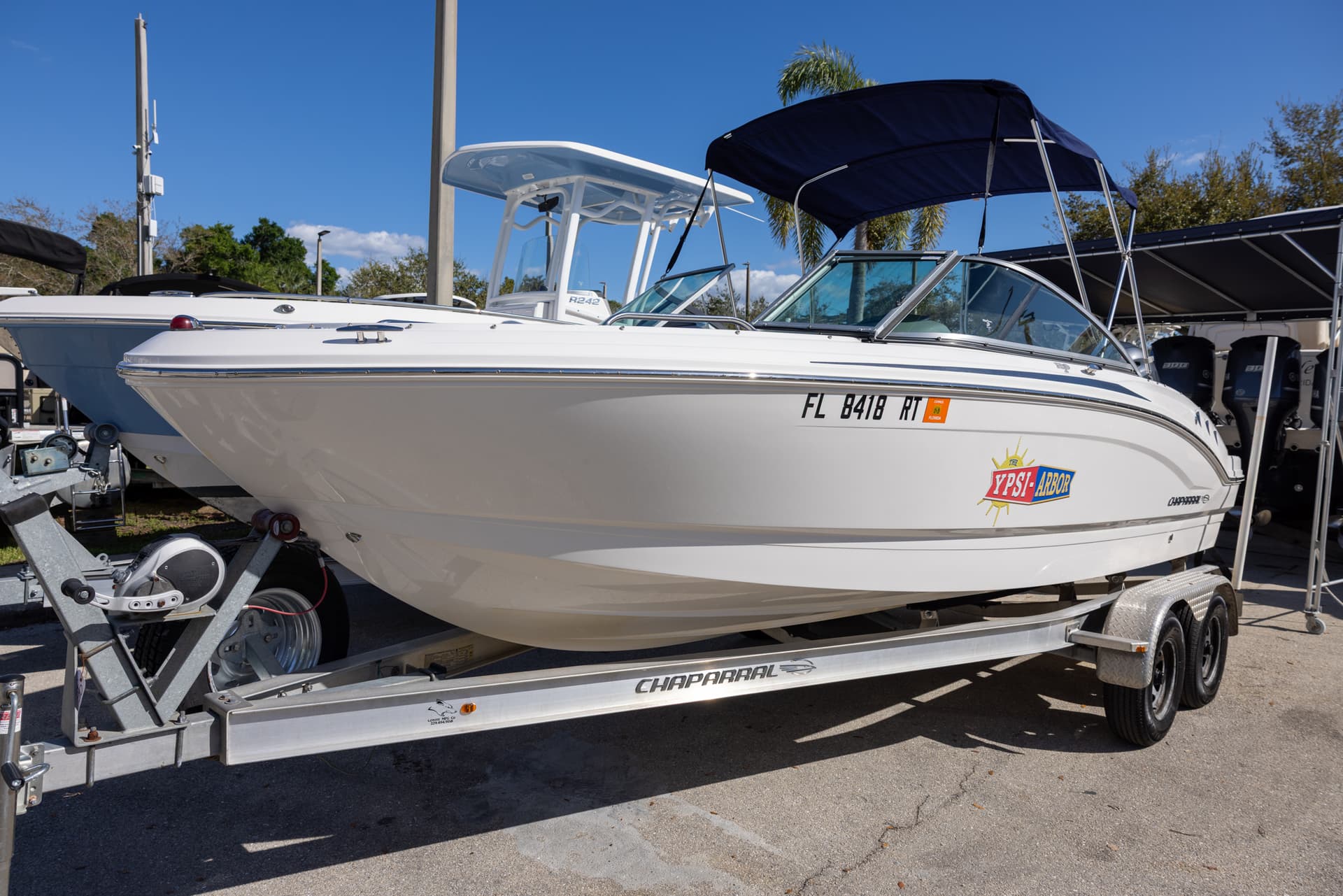
Fish Tale brands: Chaparral is one of the most respected names in the sport boat category. Their SSI and Surf series are built for families who want a beautiful boat that performs on SWFL waters. The OSX crossover models give you sport boat comfort with some fishing features built in.
What Size Boat Do You Need?
Size is the second-most-common thing first-time buyers get wrong (after type). Here's how to think about it for Southwest Florida.
Under 20 Feet
Good for: Protected water fishing (Estero Bay, Caloosahatchee River, shallow creeks), solo or with one buddy, day trips only.
These boats are affordable, easy to trailer, and simple to maintain. They're also limited. In Southwest Florida, a sub-20-foot boat restricts where you can comfortably go. A windy day on Pine Island Sound in a 17-foot center console is not a good time. And forget about crossing San Carlos Bay or running to Sanibel when the wind is blowing 15-plus out of the east.
That said, if you're exclusively fishing the backwaters, creeks, and mangrove shorelines of the Ten Thousand Islands or the upper Caloosahatchee, a smaller boat gets into places bigger boats simply can't reach.
20 to 24 Feet
The sweet spot for a lot of first-time SWFL buyers. A 22-foot center console or dual console handles the bays, the intracoastal, nearshore reefs, and calm Gulf days. You can take it to Cayo Costa on a nice day. You can fish the flats. You can bring the family.
This size range keeps trailering manageable, docking easy, and costs reasonable. For a family of four who wants to fish and cruise in protected-to-nearshore waters, this is where to start.
24 to 28 Feet
Now you're talking about real Gulf capability. A 26-foot center console with twin outboards can make a 30-mile offshore run safely and comfortably. A 27-foot dual console gives the family room to spread out and handles weather that would have you turning around in a smaller boat.
This range is where most "do-everything" SWFL boats live. You can fish inshore, run offshore when conditions allow, take the family to the islands, and feel confident in most sea states you'll encounter.
Our friend Jennifer bought a 24-foot Robalo center console last spring from our Naples store. She'd been fishing the backwaters of Marco Island in a borrowed 18-footer for years and kept running out of space (and nerve) every time she tried to push farther out. Her new boat gets her to the offshore wrecks in comfort, and she still drafts shallow enough to fish the backwaters where she started. She called it "the boat I should've bought five years ago."
28 Feet and Up
Serious offshore boats. Tournament fishing rigs. Big family cruisers. If you're running to the Dry Tortugas, fishing the deep reefs, or hosting parties on the water, this is the range.
For a first-time buyer, boats in this range come with significantly higher costs across the board: purchase price, fuel, insurance, storage, and maintenance. They also require more experience to operate safely. That doesn't mean a first-time buyer can't handle one, but be honest about your skill level and get some time on the water first.
Size for SWFL Use Cases
| Primary Use | Recommended Size | Why |
|---|---|---|
| Bay fishing (Pine Island Sound, Estero Bay) | 20-24 ft | Shallow draft, easy to maneuver in tight spots |
| Offshore fishing (Gulf reefs, wrecks) | 24-30 ft | Hull and fuel capacity for safe offshore runs |
| Family cruising and sandbar trips | 22-27 ft | Comfort, stability, and room for the family |
| Watersports | 20-24 ft | Maneuverability for towing, easy to handle |
| Entertaining and sunset cruises | 22-27 ft (pontoon/tritoon) | Maximum deck space and seating |
| All-around SWFL boat | 23-26 ft | The "Goldilocks" range for versatility |
New vs. Pre-Owned: Pros and Cons
This is a real decision, and there's no universally right answer. Here's the honest breakdown.
Buying New
The upside:
You get full factory warranty coverage. That's a big deal, especially on a first boat. When something goes wrong (and something always goes wrong eventually), you're covered. You also get to choose your exact options, colors, electronics, and engine package. Everything is zero-hours, zero-wear.
New boats from authorized dealers like Fish Tale also come with factory-trained service backing. When you buy a new Robalo, Grady-White, Chaparral, or Premier from us, our service team knows that boat inside and out because they're factory-certified to work on it.
The downside:
Depreciation. A new boat loses 15-20% of its value the moment it hits the water. If you're budget-conscious, that's real money walking away.
Buying Pre-Owned
The upside:
Someone else absorbed the depreciation hit. You can often get into a higher-class or larger boat for the same money you'd spend on a smaller new one. A three-year-old 26-foot center console might cost what a new 22-footer does.
Fish Tale carries a solid selection of pre-owned boats that our service team inspects before they hit the lot. That matters more than buying from a private seller who tells you "she runs great" while hiding the maintenance records.
The downside:
Limited or no warranty (though some manufacturer warranties transfer). Unknown history if buying private party. Potentially outdated electronics or features. And you get what's available, not exactly what you want.
Our Recommendation for First-Time Buyers
If budget allows, buy new. The warranty alone is worth it for a first-time owner who's still learning what can go wrong on a boat. If budget steers you toward pre-owned, buy from a reputable dealer, not a random listing online. And always, always get a survey (marine inspection) before writing the check.
If you've got a boat to trade in toward your purchase, we handle that too. Get a quick valuation through our trade-in tool.
Understanding the True Cost of Boat Ownership
Here's where first-time buyers get the biggest surprise. The purchase price is just the beginning.
We're not saying this to scare you off. Boating is worth every dollar. But you need to go in with your eyes open so you can budget properly and actually enjoy the experience instead of stressing about costs.
The Purchase Price
This is the obvious one. Depending on the type, size, brand, and whether you're buying new or pre-owned, you're looking at anywhere from $30,000 for a modest pre-owned center console to $300,000-plus for a premium offshore rig.
For most first-time SWFL buyers looking at a 22-to-26-foot boat, expect the new purchase price to land between $60,000 and $150,000, depending on brand and options.
Insurance
Required if you're financing (optional but strongly recommended if you're paying cash). Expect $1,500 to $4,000 per year for a typical SWFL boat. Hurricane coverage is a factor here, and policies in Southwest Florida reflect that reality.
Fuel
This varies wildly based on how often you go out, how far you run, and what engines you're pushing. A ballpark for a typical SWFL boater running 20-25 weekends a year: $2,000 to $5,000 annually. Offshore trips burn significantly more than a day in Pine Island Sound.
Yamaha outboards, which power every brand we carry, are known for fuel efficiency. That matters when gas docks are charging premium prices. Our service team at Fish Tale can help you understand real-world fuel burn for any model you're considering.
Maintenance
Oil changes, lower unit service, impeller replacements, zincs, annual detailing, bottom paint if you're in a wet slip. Budget $1,000 to $3,000 per year for routine maintenance on a single-engine boat. Twins cost more.
The 100-hour service is the big one. Our factory-authorized service center in Fort Myers handles this daily. Skipping or deferring maintenance is the fastest way to turn a minor expense into a major repair bill.
Storage
You've got three options in SWFL:
Trailer at home: Cheapest option. You need a truck to tow, space in your driveway or garage, and a nearby boat ramp. This works well for boats under 24 feet.
Dry storage: Indoor rack storage at a marina. Expect $300 to $800 per month depending on location and boat size. The marina launches your boat for you, which is convenient.
Wet slip: Your boat stays in the water at a marina. $500 to $1,500-plus per month. Most convenient, most expensive, and your boat needs bottom paint and more frequent hull maintenance.
In Southwest Florida, storage availability can be tight, especially during peak season (November through April) when snowbirds are in town. If you're planning on marina storage, start calling around before you buy the boat. Waitlists at popular marinas in Fort Myers, Naples, and Bonita Springs can stretch months long.
Registration and Taxes
Florida boat registration runs $20-to-$200 depending on size. Sales tax in Florida is 6% on boats (plus county surtax, capped at $5,000). This is a one-time cost at purchase, but it's not small on a $100,000 boat.
The 10-15% Rule
Here's the rule of thumb we share with every first-time buyer: budget 10 to 15 percent of your boat's value annually for total operating costs. If you buy a $100,000 boat, expect to spend $10,000 to $15,000 per year on insurance, fuel, maintenance, storage, and incidentals.
That sounds like a lot. And it is. But when you divide it by 25-plus weekends on the water with your family in one of the most beautiful boating regions in the world, the math starts to look pretty good.
The Sea Trial: What to Look For
Never buy a boat you haven't driven on the water. Period.
A sea trial isn't a joyride. It's your chance to evaluate the boat under real conditions before you commit. At Fish Tale, we offer sea trials by appointment at all three of our SWFL locations. Here's how to make the most of one.
Before You Go
Wear clothes you don't mind getting wet. Bring polarized sunglasses. Bring whoever is going to spend the most time on the boat with you, especially your spouse. If your partner hates the boat, you're going to have a problem, and it's better to know before you sign.
Make a short list of things you want to test. Don't wing it.
What to Test on the Water
The ride at cruising speed. Get the boat up on plane and run at normal cruising RPM. How does it feel? Is the ride smooth or jarring? In SWFL, you're going to encounter wind chop in the bays and swells in the Gulf. Feel how the hull handles it.
Handling at slow speed. How does it maneuver in tight spaces? How does it handle at idle in a no-wake zone? This matters because you'll spend a lot of time at slow speed in Florida's waterways, and a boat that's squirrelly at idle is going to frustrate you every time you dock.
Acceleration and hole shot. How quickly does the boat get up on plane? A sluggish hole shot with a full load means you're either underpowered or overweight. Both are problems.
Visibility from the helm. Can you see the waterline in front of the boat? Can you see behind you when backing down? Can you see the depth finder, GPS, and gauges without hunching over?
Noise and vibration. Some vibration is normal. Excessive rattling or engine noise is not. Pay attention.
Seating and layout. Sit in every seat. Open every hatch. Check the fish boxes. Try the head. Make sure the things you'll use most are accessible and functional.
Questions to Ask
- What's the real-world fuel economy at cruising speed?
- What's the warranty coverage, and what does it include?
- What engine package does this boat need for the way I'll use it?
- What's the recommended maintenance schedule?
- How does this model handle in rough water?
Mark came in last fall looking at two different 24-foot center consoles. On paper, they were nearly identical. On the water, one tracked straight and handled the chop in San Carlos Bay without complaint. The other wandered at cruise and pounded in the same conditions. Thirty minutes on the water saved him from a $90,000 mistake. That's what a sea trial is for.
Bring a Checklist
It's easy to get caught up in the excitement and forget half the things you wanted to evaluate. Before your sea trial, write down your top five priorities and check them off as you go. If comfort is important, sit in every seat at cruising speed. If fishing is the priority, try casting from different positions. If you're worried about rough water, ask the captain to find some chop so you can feel the hull work.
A sea trial should last at least 30 minutes on the water. Anything less and you're not getting the full picture. Don't let anyone rush you.
Trust Your Gut
If something feels off during the sea trial, trust that feeling. Don't let excitement override your instincts. There are always more boats. There's only one right boat for you.
Financing Your First Boat
Most first-time buyers finance their boat, and that's perfectly normal. Boat loans work a lot like auto loans, but there are a few differences worth knowing.
How Boat Loans Work
Boat loans typically run 10 to 20 years depending on the loan amount and lender. Interest rates vary based on credit score, loan term, and the age of the boat. New boats generally qualify for better rates than pre-owned.
Down payments typically range from 10% to 20%. The more you put down, the better your rate and monthly payment.
What You'll Need
Lenders generally want to see:
- Credit score of 680 or higher for the best rates
- Proof of income
- Two years of tax returns (for self-employed buyers)
- Information about your current debts and assets
Getting Pre-Approved
Here's a tip that will save you time and give you negotiating clarity: get pre-approved before you start shopping seriously. You'll know exactly what you can afford, and you won't fall in love with a boat that's outside your budget.
Fish Tale Boats works with multiple marine lenders to find competitive rates. You can get pre-approved online in minutes, or visit our financing page for more details.
Want to run the numbers yourself first? Use our boat loan calculator to estimate monthly payments for different price points, down payments, and terms.
A Note on Extended Warranties
Some lenders and dealers offer extended warranty packages. For a first-time buyer, an extended powertrain warranty on the engines can be worth the cost. Outboard engines are reliable, especially Yamaha, but a major repair outside of warranty is a five-figure event. Evaluate it on a case-by-case basis.
First-Time Buyer Mistakes to Avoid
We've seen every mistake in the book over the past 30 years. Here are the ones that come up most often.
Buying Too Small
This is the number-one mistake. First-time buyers often go conservative on size because of budget, trailer concerns, or intimidation. Then they spend two years wishing they had more room, more capability, and more range.
In Southwest Florida, where conditions range from glass-calm bays to three-foot Gulf chop, a boat that's even two feet longer can make a dramatic difference in ride quality and confidence.
Buy the boat that fits your needs for the next five years, not just today. If you can afford a 24-footer, don't buy a 20-footer to save money you'll spend upgrading in two years anyway.
Ignoring Total Cost of Ownership
We covered this in detail above. The purchase price is 60-70% of your first-year cost. If you budget only for the boat and then get hit with insurance, storage, fuel, and maintenance, the whole experience becomes stressful instead of enjoyable.
Know your total annual cost before you sign anything.
Skipping the Sea Trial
It happens more than you'd think. A buyer falls in love with a boat online or on the showroom floor, gets excited, and writes a check without ever driving it on the water. Don't be that person. Schedule a sea trial at Fish Tale. It's free, it's easy, and it could save you from a costly mistake.
Not Considering Storage
Here's a scenario we see regularly: someone buys a 26-foot boat, gets it home, and realizes it doesn't fit in their garage, their HOA won't allow it in the driveway, and the nearest dry storage facility has a six-month waitlist.
Figure out where the boat will live before you buy it. Call the marinas. Check your HOA rules. Measure your garage. This is not a problem you want to solve after the fact.
Buying for the Exception, Not the Rule
We talked about Dave earlier. He's the rule, not the exception. Most first-time buyers overweight the aspirational trips (offshore tournaments, island-hopping adventures) and underweight the regular trips (sandbar Saturdays, after-work fishing in the bay).
Buy for the 80%. The other 20% will work itself out.
Skipping the Boating Safety Course
Florida doesn't require a boating safety course for everyone, but the Florida Fish and Wildlife Conservation Commission offers one, and it's worth your time. You'll learn navigation rules, safety protocols, and local regulations that'll make you a more confident and safer operator from day one.
[Discover Boating](https://www. discoverboating.com) is another great resource for first-time buyers looking to build their knowledge base.
Not Bringing Your Spouse or Partner
If someone else in your household is going to spend time on this boat, they need to be part of the decision. We can't count the number of times a buyer came back sheepishly because their partner tried the boat and hated it. The seating was wrong. The ride was too rough. There was no shade. Involve them from the start.
Rick and Sarah came into our Bonita Springs location last December. Rick had already picked out a 26-foot center console, had the financing lined up, and was ready to sign. Sarah took one look at the open layout, asked where she was supposed to sit comfortably for a four-hour trip to Keewaydin Island, and the conversation changed completely. They ended up in a Grady-White Freedom dual console, and now they're on the water together almost every weekend. If Rick had bought that center console solo, it would've been his boat, not their boat. That's an important difference.
Choosing the Wrong Dealer
This might be the most expensive mistake of all, and it's the one people think about least. A boat is a long-term relationship with the dealer who sells it and services it. You need warranty support, routine maintenance, parts availability, and someone who answers the phone when something goes wrong at 7 AM on a Saturday.
Fish Tale Boats has been family-owned since 1996. Three SWFL locations. Factory-authorized service for every brand we carry. And a parts and service department staffed with people who actually know boats, not just parts numbers. That matters more than you think on the day something breaks.
Frequently Asked Questions
What is the best type of boat for a beginner in Southwest Florida?
For most first-time SWFL buyers, a 22-to-24-foot center console or dual console is the best starting point. It handles the bays, nearshore waters, and island trips comfortably while leaving room to grow into offshore fishing. If your priorities lean toward family comfort and entertainment, a tritoon in the same size range is a strong choice.
How much does a first boat typically cost in Southwest Florida?
A new boat in the most popular first-buyer range (22-26 feet) typically runs $60,000 to $150,000 depending on brand, type, and engine package. Pre-owned boats in good condition start around $30,000 to $50,000. Remember to budget 10-15% of the boat's value annually for operating costs.
Do I need a boating license in Florida?
Florida requires a Boating Safety Education ID Card for operators born on or after January 1, 1988. You can get it by completing an approved course through the Florida Fish and Wildlife Conservation Commission. Even if you're exempt, the course is highly recommended for first-time boaters.
Should I buy new or pre-owned for my first boat?
Both are good options. New boats offer full warranty, current features, and the ability to customize. Pre-owned boats offer better value and potentially a larger or better-equipped boat for the same budget. If you're unsure, browse both our new inventory and pre-owned inventory to compare.
What size boat do I need to go offshore in the Gulf of Mexico?
For safe and comfortable offshore fishing out of Southwest Florida, we recommend a minimum of 24 feet with twin outboards and a deep-V hull. Many experienced offshore anglers run 26-to-30-foot center consoles. The Gulf can build quickly, and you want enough boat to handle unexpected weather on the way home. Check out our offshore fishing guide for more detail.
How much does boat insurance cost in Florida?
Boat insurance in Southwest Florida typically runs $1,500 to $4,000 per year depending on the boat's value, size, your experience, and whether your policy includes hurricane and liability coverage. If you're financing, your lender will require insurance. Even if you're paying cash, we strongly recommend it.
Can I trailer my boat or do I need a marina slip?
Boats under 24 feet are generally easy to trailer with a mid-size truck or SUV. Boats over 24 feet usually need a heavy-duty truck and more ramp experience. If you don't want to deal with trailering, dry storage and wet slips are available at marinas throughout Fort Myers, Naples, and Bonita Springs. Figure out your storage plan before buying.
What is a sea trial and do I really need one?
A sea trial is an on-water test of the boat you're considering buying. Yes, you really need one. It's the only way to evaluate how a boat handles, rides, accelerates, and feels at the helm under real conditions. Fish Tale Boats offers sea trials by appointment at all three locations. Contact us to schedule yours.
What engine brand should I look for?
Every boat at Fish Tale comes with Yamaha outboards, and there's a reason for that. Yamaha has the best reliability track record in the industry, the best dealer network, and the best resale value. As a Yamaha Key Dealer, we stock parts, have factory-trained technicians, and can handle warranty work in-house.
How long does it take to buy a boat?
The process can move as fast as you're comfortable. Some buyers come in knowing exactly what they want and take delivery within a week. Most first-time buyers take two to four weeks from first visit to closing, including sea trial, financing, and paperwork. Custom-ordered boats from the factory can take two to four months.
Ready to Find Your First Boat?
You've done the research. You know what type, size, and budget makes sense for your life on Southwest Florida waters. The next step is simple: come see the boats in person.
Fish Tale Boats has been helping first-time buyers find the right boat since 1996. We're a family-owned dealership with three locations across SWFL:
- Fort Myers: Our headquarters with the largest inventory and a 14,000-square-foot service center
- Naples: Serving Collier County boaters
- Bonita Springs: Conveniently located at Bonita Bay Marina
We carry Grady-White, Robalo, Chaparral, and Premier Pontoons, all backed by Yamaha outboards and our factory-authorized service team.
Whether you're ready to schedule a sea trial, want to browse our inventory, or just have questions, we're here to help. No pressure, no gimmicks. Just honest advice from people who've been matching SWFL families with boats for three decades.
Contact us today to schedule a visit or sea trial. Or start your journey by getting pre-approved for financing so you know exactly where you stand.
See you on the water.