
We had a conversation at our Fort Myers showroom last month that we've had about a hundred times now.
Mike and Lauren brought their two girls in on a Saturday morning. Mike grew up fishing on a Robalo center console. Lauren grew up waterskiing at a lake house in North Carolina. They had been going back and forth for six months about what boat to buy. He wanted something that could fish the flats. She wanted something the whole family could enjoy without everybody getting soaked and sunburned.
Then Mike said something that stopped the conversation: "Honestly, we spend most weekends anchored at a sandbar while the kids swim and we cook lunch. We fish maybe once a month."
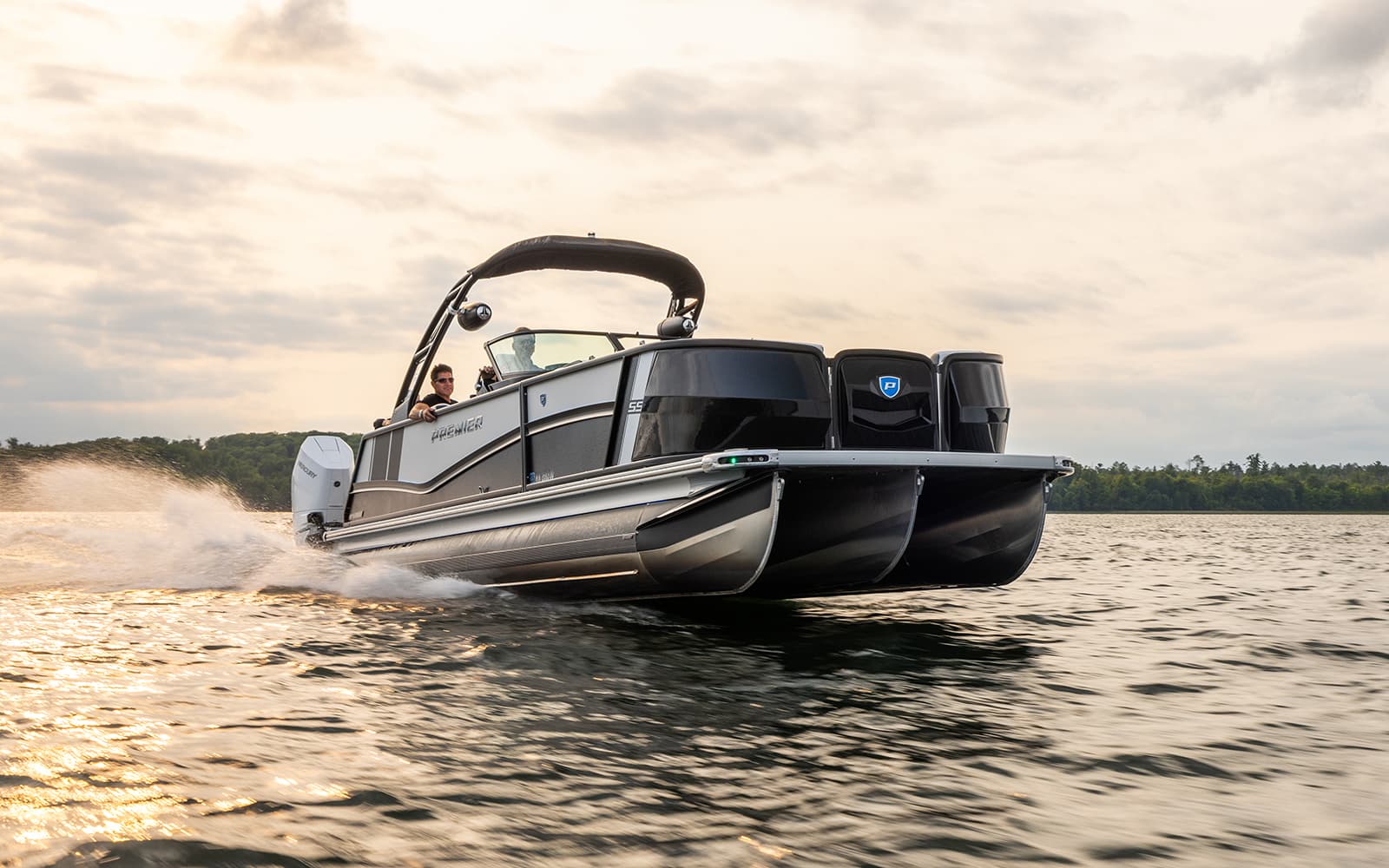
That changed everything. Because the boat they needed wasn't a center console, wasn't a dual console, and wasn't a deck boat. It was a pontoon. Specifically, a Premier Pontoon with the PTX tritoon chassis and SaltEx saltwater package. And it was nothing like what either of them pictured when they heard the word "pontoon."
If you're a family in Southwest Florida weighing your options, this guide is for you. We're going to walk through everything you need to know about pontoon boating in SWFL, from saltwater capability to the best anchorages, from sizing to true ownership costs. No sales pitch. Just straight information from people who sell and service these boats every day.
Why Pontoons Are Exploding in Southwest Florida
Let's address the elephant in the room. When most people think "pontoon boat," they picture their uncle's 20-year-old aluminum barge puttering around a Minnesota lake at 8 miles per hour, a cooler of beer in the middle and a canopy that looks like it survived a hurricane (barely).
That boat exists. And it has nothing to do with what's happening in Southwest Florida right now.
Pontoon sales in the saltwater market have grown steadily over the past five years, and the boats driving that growth look, feel, and perform nothing like pontoons from even a decade ago. The modern pontoon, especially a tritoon with the right chassis, is a legitimate saltwater platform that's fast, stable, fuel-efficient, and tough enough for daily use in our waters.
Here's what changed.
The tritoon revolution. Adding a third tube underneath a pontoon boat wasn't just an incremental improvement. It fundamentally changed the performance envelope. A tritoon sits lower in the water, planes faster, handles rougher conditions, and supports significantly more horsepower. The Premier PTX tritoon chassis takes it a step further with a U-shaped center tube (either 30 inches or 36 inches) that has a flat planing surface instead of a round bottom. That flat surface means the boat rides on a hull shape, not just on tubes. It delivers 23% greater hull volume than competitors' round tubes, which translates to better buoyancy, faster planing, and a more stable ride.
Saltwater engineering caught up. The reason pontoons were "lake boats" for so long wasn't because the concept was flawed. It was because the construction wasn't built for salt. Aluminum corrodes in saltwater unless you engineer around it. Manufacturers like Premier figured out how to build pontoons that genuinely handle saltwater, not just survive it.
Southwest Florida is the perfect environment. Here's what people miss. SWFL's boating environment is tailor-made for pontoons. We have calm, protected bays. Shallow rivers and canals. Sandy, flat-bottomed anchorages. Island beaches with gentle approaches. You don't need a deep-V hull to handle Estero Bay on a Saturday morning. You need a stable, comfortable platform that drafts shallow and gives your family room to spread out. That's literally what a pontoon is.
The result? We see families every week who came in looking at a Chaparral deck boat or a Robalo dual console and end up seriously considering a Premier Pontoon once they understand what these boats can actually do.
Pontoon vs. Tritoon: What's the Difference?
This is the first question we get, so let's make it simple.
A pontoon has two aluminum tubes (called "toons" or "logs") running the length of the boat. The deck sits on top of those tubes. Two tubes provide buoyancy and basic stability. Traditional pontoons, the kind you see on inland lakes, are almost always twin-tube designs.
A tritoon has three tubes. The third tube sits between the other two, centered underneath the deck. That third tube does several things at once: it adds buoyancy (so you can carry more weight and power), it adds stability (the wider base resists rocking), and it creates a hull-like surface that dramatically improves how the boat rides and handles.
The Performance Difference Is Real
On a twin-tube pontoon, you're limited to maybe 150 HP. The boat sits high on the water, and in any kind of chop, it tends to slap and bounce because the tubes are round and don't cut through waves.
A tritoon like the Premier PTX can handle up to 450 HP. The center tube's flat planing surface acts more like a traditional hull. That means the boat gets on plane faster, turns tighter (Premier claims a 5% tighter turning radius than competitors), and is about 17% more fuel-efficient because it's not fighting the water as much.
To put real numbers on it: a Premier Sunsation 230 tritoon with a 200 HP outboard will cruise comfortably at 25-30 mph, top out around 45 mph, and sip fuel while doing it. That's real boat performance, not pontoon-with-an-asterisk performance.
Which Should You Choose?
If you're boating in Southwest Florida, get the tritoon. Full stop. Twin-tube pontoons are fine for calm, freshwater lakes where you never exceed 20 mph and the biggest wave you encounter is from a passing jet ski. But SWFL has tidal currents, afternoon chop in the bays, boat wakes in the Intracoastal, and the occasional crossing that puts you in open water. You want the third tube.
The price difference between a twin-tube and a tritoon of the same length is typically $5,000-$15,000 depending on the model. In our experience, every customer who started with a twin-tube and upgraded to a tritoon says the same thing: "I'm glad I spent the extra money."
Can You Really Use a Pontoon in Saltwater?
Yes. But not just any pontoon.
This is the question that brings people into our showroom with a mix of excitement and skepticism. They've seen pontoons on the Caloosahatchee River. They've noticed them anchored at Bunche Beach sandbars. They're intrigued. But somebody on a boating forum told them that "saltwater will eat your pontoon alive in two years," and now they're worried.
Here's the truth: an unprotected aluminum pontoon in saltwater will corrode. That's not speculation. It's chemistry. Aluminum reacts with salt, especially in the presence of dissimilar metals (which are everywhere on a boat, from stainless steel fittings to the engine). Without proper protection, you'll see pitting, galvanic corrosion, and structural degradation.
So how does a Premier Pontoon handle saltwater? Through what they call the SaltEx package, and it's worth understanding what that actually means in plain English.
The SaltEx Package, Explained Like a Normal Person
Thicker aluminum. Standard pontoon aluminum is typically .063 inches thick. The SaltEx package uses .090-inch aluminum on the tubes and .125-inch aluminum on the structural components. That's 40-100% thicker. More material means more margin before any corrosion becomes a structural issue.
Zinc anodes. This is the oldest trick in the marine industry, and it works. Zinc is more "reactive" than aluminum, so when you bolt zinc anodes onto the tubes and running gear, the zinc corrodes instead of the aluminum. Think of it as a sacrificial shield. You replace the zincs periodically (we recommend checking them every 6 months in SWFL waters), and your tubes stay clean.
Sealed strakes. Strakes are the small fins welded onto the tubes that help with lift and stability. On a standard pontoon, water can pool inside strake channels. In saltwater, that standing water accelerates corrosion. The SaltEx package seals those channels so water drains completely.
Z-channel supports every 16 inches. The crossbeams that connect the tubes to the deck frame are spaced 16 inches apart (closer than the industry standard) and use a Z-channel design that's stronger and drains better than traditional flat brackets.
Solid-welded keel. The bottom of each tube has a continuous weld along the keel line. No gaps, no skip welds, no places for salt and debris to accumulate.
Put it all together and you have a pontoon that's engineered from the start for daily saltwater use, not a freshwater boat with a couple of bolt-on accessories and a prayer.
Best Places to Pontoon in Southwest Florida
This is where pontoons genuinely shine. Southwest Florida has some of the best pontoon waters in the entire country, and most of them are within 30 minutes of our Fort Myers, Naples, and Bonita Springs locations.
Where Pontoons Are Perfect
Estero Bay. This is pontoon paradise. A shallow, protected estuary between Fort Myers Beach and Bonita Springs, Estero Bay rarely sees more than a 1-foot chop even on windy days. The water averages 3-6 feet deep, the bottom is mostly sand and grass, and the shorelines are lined with mangrove islands. Anchor up, throw out the swim ladder, and let the kids snorkel over sea grass beds. A pontoon's shallow draft (typically 18-24 inches) means you can tuck into spots that deeper-V hulls can't reach.
Caloosahatchee River. From the Cape Coral Bridge upstream to the W. P. Franklin Lock, the Caloosahatchee is wide, calm, and essentially a pontoon highway. There are waterfront restaurants with docks (The Nauti Mermaid, Pinchers at the Marina), sandbars that emerge at low tide, and plenty of room to cruise at speed. The river is also where a lot of SWFL families learn to boat, and a pontoon's stability makes it an ideal learning platform.
Pine Island Sound. The protected water between Pine Island and the barrier islands (Sanibel, Captiva, Cayo Costa, North Captiva) is spectacular. It's shallow (4-8 feet in most places), calm in the mornings, and dotted with small islands, oyster bars, and sandy beaches. A pontoon draft of under 2 feet means you can explore spots that keep the bigger boats in the channels.
Cape Coral Canals. With over 400 miles of navigable canals, Cape Coral is basically a giant pontoon playground. Slow-speed zones keep the wakes down, and the canals connect to the Caloosahatchee and eventually to the Gulf. Plenty of Cape Coral families keep pontoons on their backyard lifts and use them as daily transportation to restaurants, friends' houses, and the river.
Lovers Key and Bunche Beach Sandbars. On any given weekend, the sandbars near Lovers Key State Park and Bunche Beach look like a floating tailgate party. Dozens of boats anchor in 2-3 feet of water, people set up chairs and coolers in the shallows, and kids run between boats. A pontoon is the ideal sandbar boat because of the deck space (you're not climbing over gunwales and consoles), the shallow draft, and the swim ladder access.
Cayo Costa State Park. The beach on the Gulf side of Cayo Costa is one of the most beautiful in Florida. Getting there requires a boat, which means it stays relatively uncrowded. The approach from Pine Island Sound is shallow and calm, perfect for a pontoon. Pack a cooler, bring beach chairs, and spend the day on a barrier island with no cars and no crowds. Sarah and Dan, regulars at our Bonita Springs location, told us they bought their Premier Solaris specifically for Cayo Costa weekends. "We go every other Saturday from October through May," Sarah said. "The kids call it their island."
Keewaydin Island. South of Naples, Keewaydin is another boat-access-only barrier island with beautiful Gulf beaches. The approach through Rookery Bay is well-marked and manageable for a pontoon on calm days, though you'll want to pay attention to tides and weather.
Where Pontoons Are Not the Right Choice
Let's be honest about the limits.
Offshore Gulf of Mexico. Anything beyond about a mile offshore is not pontoon territory. If you want to run to the reefs 9 miles out or chase kingfish in 60 feet of water, you need a center console or a Grady-White with a proper deep-V hull. Pontoons are bay and near-coastal boats. They handle light chop, not 3-foot Gulf swells.
Rough passes. San Carlos Pass (between Fort Myers Beach and Estero Island) and Gordon Pass (Naples) can get nasty on an outgoing tide with a west wind. A pontoon can transit these passes on calm days, but you need to pick your weather window. If you're looking at whitecaps in the pass, stay inside.
Big open water crossings. Running across Charlotte Harbor in 20-knot winds? That's not a pontoon day. The flat deck catches wind, and the tubes can slam in steep, short-period chop. Stay in protected water or wait for calmer conditions.
The good news? Probably 80% of what families do in Southwest Florida, from sandbar hopping to canal cruising to island picnics, falls squarely in a pontoon's comfort zone.
What Size Pontoon Do You Need?
Size matters more than most people think, and the answer depends on three things: who's on board, where you're going, and where you're storing the boat.
18-22 Feet: The Canal Cruiser
Best for couples and small families (2-4 people) who primarily boat the canals, rivers, and protected bays. A 20-foot pontoon fits on most residential lifts in Cape Coral and Fort Myers, is easy to trailer, and is nimble enough for tight canal turns. Power is typically 90-150 HP.
The downside: limited deck space for larger groups, and the smaller tubes mean a wetter ride in any kind of chop. If you're planning to venture into Estero Bay or Pine Island Sound regularly, you'll feel the size limitation on windier days.
22-26 Feet: The SWFL Sweet Spot
This is where most of our SWFL pontoon customers land, and for good reason. A 23-25 foot tritoon gives you enough deck space for 8-12 people comfortably, enough power (200-300 HP) to cruise at 25-30 mph, a shallow draft for sandbar access, and enough hull to handle normal bay chop without beating you up.
The Premier Sunsation 230 is our most popular model in this range. It sits on the PTX tritoon chassis, handles up to 250 HP, and has the SaltEx package as an option. It's the "fits 90% of SWFL families" boat.
At 25-26 feet, you're getting into the Premier Solaris territory. More seating, more features (wet bar, premium audio, upgraded upholstery), and the ability to handle 300 HP for faster cruising. If you regularly boat with extended family or groups of 8+, the extra 2-3 feet makes a noticeable difference.
26+ Feet: The Entertainer
For families who boat with large groups, host frequently, or simply want maximum space and features. The larger Premier models, including the Solaris series and the flagship Escalante, are floating living rooms. The Escalante can handle twin engines (up to 900 HP combined on the top configuration), which is a sentence that would have been absurd to write about a pontoon ten years ago.
At this size, you're looking at features like full wet bars, refrigerators, electric-actuated bimini tops, JL Audio marine sound systems, and seating layouts that rival your living room. The trade-off is storage. A 28-foot tritoon needs a large lift or a marina slip, and it's not going on a trailer behind your SUV.
A Note About Cape Coral Lifts
If you live in Cape Coral and plan to keep the boat on a backyard lift, measure first. Many residential lifts max out at 22-24 feet, and the wider beam of a pontoon (8-8.5 feet) means you need a lift rated for the width, not just the length. We've seen more than a few customers fall in love with a 26-footer and then discover their lift can't handle it. Check with your lift company before you buy.
Pontoon Safety for Families
A pontoon's stability makes it one of the safest boat designs on the water. But "safer" doesn't mean "no precautions required." Here's what every SWFL pontoon family needs to know.
Life Jackets Are Non-Negotiable
Florida law requires a U. S. Coast Guard-approved life jacket for every person on board. Children under 6 must wear one at all times when the boat is underway. We recommend that all kids under 12 wear life jackets whenever the boat is moving, regardless of what the law says.
A pontoon's open deck is great for space, but it also means there are no enclosed areas keeping kids contained. They can move from bow to stern freely, which is a feature until you hit a wake and a 40-pound kid loses their balance. Quality life jackets solve this. Check the FWC boating safety page for full requirements.
Sun Protection
You will underestimate SWFL sun. Everyone does. A full bimini top is essentially required equipment here, not an option. But even with a bimini, the sun reflects off the water from every direction. Apply reef-safe sunscreen before you leave the dock, reapply every two hours, and bring UV-protective shirts for the kids. Dehydration sneaks up fast on the water, so bring twice as much water as you think you need.
Weather Awareness
Southwest Florida weather is predictable in its unpredictability. Summer afternoons bring thunderstorms that build fast, move fast, and carry dangerous lightning. Here's the routine:
- Check the marine forecast before you leave.
- Watch the western sky all afternoon.
- If you see towering cumulus clouds building, head in. Don't wait for rain.
- Lightning on the water is a life-threatening emergency. A pontoon is an aluminum platform on open water. If a storm is approaching, get to shore or under a bridge immediately.
Most experienced SWFL boaters plan their summer trips for mornings and are off the water by 2 PM. That's not overly cautious. That's smart.
Kids on Board
A few rules that experienced pontoon families swear by:
- Assign seats while underway. Kids can move around at anchor, but when the boat is running, everyone sits.
- No dangling legs. The gap between the deck and the water is inviting for little legs. Keep feet on the deck, not hanging over the edge, while the boat is moving.
- Designate a spotter. When kids are swimming off the boat, one adult watches the water. That's their only job. No phone, no conversation, no eating. Just watching.
- Engine kill switch. Modern outboards have emergency engine cutoff switches (ECOS). Wear the lanyard. If you go overboard, the engine stops. This is law on all boats built after 2020, but it applies to the operator's behavior too.
No-Go Zones
Manatee zones (idle speed or slow speed) are marked throughout SWFL waterways. Obey them. Manatees are slow, hard to see, and easily injured by propellers. Beyond the legal requirement and the fines, running over a manatee is something you don't want on your conscience.
Also, stay clear of marked seagrass beds. Running a pontoon through shallow grass tears up habitat that takes years to recover.
Can You Fish From a Pontoon?
This is the question that makes traditional anglers roll their eyes. And then we put them on a properly rigged pontoon and watch them come around.
Can you run offshore and troll for mahi from a pontoon? No. Can you sight-fish redfish on a skinny-water flat with a technical poling skiff? Also no. But can you catch snook under the docks, trout over the grass flats, sheepshead around the pilings, and mangrove snapper in Estero Bay from a pontoon? Absolutely. And you can do it while your family sits comfortably instead of baking on a casting deck.
What Makes a Pontoon Fishable
Rod holders. Most pontoon manufacturers offer integrated rod holders, and aftermarket options are endless. A set of flush-mount rod holders in the stern rail and a couple of vertical holders near the bow give you everything you need for inshore fishing.
Livewells. Several Premier models come with integrated livewells, or you can add an aftermarket portable unit. Live shrimp and pilchards stay alive. Fish stay fresh.
Casting space. The flat, open deck of a pontoon is actually excellent for casting. No gunwales to hook, no windshields to hit, no T-top frames in the way. Stand anywhere on the deck and throw a cast net or flip a live bait under a dock.
Shallow draft. Pontoons draft 18-24 inches, which puts you in the same water as dedicated flats boats. You can ease into skinny water along mangrove shorelines where the redfish and snook live.
Silence. A pontoon at idle is remarkably quiet. Aluminum tubes don't slap the water the way fiberglass hulls do. Drift into a flat on a calm morning and the fish don't spook the way they do when a deep-V hull pushes a wake.
The Fishing Pontoon Setup
Tom, one of our regulars from Cape Coral, fishes his 24-foot Premier four days a week in the Caloosahatchee and Pine Island Sound. He added four flush-mount rod holders, a Yeti cooler as a casting platform in the bow, a small trolling motor on a bracket, and a portable livewell. "I've caught more snook from this pontoon than I ever did from my bay boat," he told us. "I can get into the same water, I'm quieter on the approach, and when my grandkids come along, they're not sitting on a 110-degree casting deck. They're under the bimini with a juice box."
Is a pontoon as good a fishing platform as a dedicated center console or Grady-White? No. It's not designed to be. But for the SWFL family that wants to fish the flats and bays while keeping everyone comfortable, it's surprisingly capable.
Pontoon vs. Deck Boat vs. Dual Console for Families
This is the three-way comparison that drives our showroom conversations. All three boat types claim to be "the family boat." Here's an honest breakdown of when each one makes sense.
Pontoons Win When...
Deck space is the priority. Nothing beats a pontoon for usable space per foot of boat. A 24-foot pontoon has more usable square footage than a 27-foot deck boat. The flat, open layout means more seats, more room to move, and more places to put coolers, gear, and kids.
Stability matters. A pontoon on three tubes is the most stable platform on the water. It doesn't rock at anchor the way a V-hull does. For families with small children, elderly passengers, or anyone who gets seasick easily, this is a significant advantage.
Shallow water access. An 18-24 inch draft means you can beach the boat, anchor in skinny water, and access shorelines that deeper hulls can't reach.
Budget-friendly boating. Dollar for dollar, you get more boat with a pontoon than with a fiberglass hull of the same length. A well-equipped 24-foot Premier tritoon costs less than a comparable Chaparral or Robalo, and the fuel efficiency advantage (17% better, per Premier's numbers) compounds over years of ownership.
Customization. The modular deck layout means you can configure seating, fishing stations, wet bars, and entertainment systems to match how your family actually boats.
Deck Boats and Dual Consoles Win When...
You want to run offshore. If your boating includes regular trips beyond the bays, into the Gulf, or to the 9-mile reef, you need a hull designed for open water. A Chaparral deck boat or a Robalo dual console with a deep-V hull handles Gulf conditions that would send a pontoon running for the pass. Check out our center console vs. dual console guide for a detailed comparison of those two options.
Speed matters. While modern tritoons are fast, a comparable fiberglass hull is still faster at the same horsepower. If running 50+ mph is part of the appeal, a deck boat or sport boat is the better choice.
Rough water is regular. If you're crossing Charlotte Harbor, transiting San Carlos Pass, or running the Intracoastal on busy weekends regularly, a V-hull cuts through wakes and chop more comfortably than tubes.
Aesthetics are important. This is subjective, but some buyers simply prefer the look of a fiberglass hull. A Chaparral or Grady-White has a different visual presence than a pontoon.
The Honest Answer
Most families in SWFL who primarily boat the bays, rivers, canals, and protected coastal waters would be well-served by a tritoon. The families who need to cross open water, fish offshore, or transit rough passes regularly need a V-hull. If you're genuinely split, come see both at our showroom. Sit on a Premier Sunsation and then sit on a Chaparral 280 OSX back to back. The right one usually becomes obvious in about ten minutes.
Maintenance and Care for Saltwater Pontoons
A saltwater pontoon is more demanding than a freshwater one. That's the reality. But the maintenance routine is straightforward, and if you stay on top of it, a well-built tritoon like a Premier with the SaltEx package will last 15-20+ years in SWFL waters.
The Post-Trip Routine (Every Trip)
Freshwater rinse. This is the single most important thing you can do. After every saltwater trip, rinse the entire boat with fresh water. The tubes, the deck, the hardware, the engine. Everything. Salt left on aluminum starts working immediately. A 15-minute rinse at the dock (or on the trailer with a garden hose) prevents 90% of corrosion issues.
Engine flush. Run your outboard's flush system (or use flush muffs) with fresh water for at least 10 minutes after every saltwater use. This cleans salt from the cooling system, which is where most engine corrosion starts.
Dry it out. Drop the drain plug and let any standing water drain completely. Open storage compartments and hatches to air out. Standing saltwater in enclosed spaces is corrosion accelerant.
Monthly Maintenance
Inspect the zincs. Check your zinc anodes monthly. If they're more than 50% depleted, replace them. Zincs are cheap (a few dollars each). The tubes they protect are not. Our service department keeps zincs in stock for every Premier model.
Check the hardware. Look for any discoloration, pitting, or white powder on aluminum surfaces. Check stainless steel fittings for rust streaks (which indicate galvanic corrosion). Catch it early and it's an easy fix. Ignore it and it becomes an expensive one.
Clean the upholstery. Marine vinyl doesn't love salt and sun. Wipe down seats and cushions with a mild cleaner and apply a UV protectant every month. This prevents cracking, fading, and mildew.
Seasonal Maintenance
Bottom paint or antifouling coating. If you keep your pontoon in the water (on a lift or at a slip), you'll need antifouling paint on the tubes. Without it, barnacles and marine growth will coat the aluminum within weeks. Our service team applies barrier coat and antifouling paint to the tubes, which needs to be refreshed annually.
If your boat lives on a trailer or a high-and-dry lift, you can skip bottom paint, but inspect the tubes for any growth or pitting every time you haul the boat.
Annual tube inspection. Once a year, pull the boat and inspect the tubes closely. Look for pitting, weld cracks, and any areas where the aluminum has thinned. A professional marine surveyor can do a thickness test with an ultrasonic gauge if you want precise measurements. Premier's thicker SaltEx aluminum (.090 and .125 inch) gives you substantially more margin than standard construction.
Electrical system check. Saltwater and electrical connections are natural enemies. Inspect all wiring connections for corrosion, check battery terminals, and test navigation lights annually.
The Lift Advantage
The number one thing you can do for a saltwater pontoon's longevity is keep it out of the water when you're not using it. A boat lift, whether it's a backyard lift in Cape Coral or a rack at a marina, dramatically reduces marine growth, galvanic corrosion, and hull exposure. If you have the option, lift storage is always preferable to leaving the boat in the water.
The True Cost of Pontoon Ownership
Let's talk money honestly. Nobody likes surprises after they've already signed paperwork.
Purchase Price
New pontoon pricing varies widely based on size, power, and features:
- 18-20 foot twin-tube (basic): $30,000-$50,000
- 22-24 foot tritoon (mid-range, SaltEx): $60,000-$90,000
- 24-26 foot tritoon (well-equipped): $85,000-$130,000
- 26-30 foot tritoon (premium/flagship): $130,000-$250,000+
The Premier Sunsation 230 with a tritoon chassis, SaltEx package, and a 200 HP outboard, which is our most popular configuration for SWFL families, typically falls in the $70,000-$90,000 range depending on options.
For comparison, a similarly sized Chaparral or Robalo in the 23-25 foot range typically runs $80,000-$120,000+. Pontoons offer more deck space at a lower price point per square foot than fiberglass hulls.
We also carry pre-owned boats including used pontoons that can save 20-40% off new pricing. And financing is available with competitive rates. You can get pre-approved before you even visit the showroom, or use our boat loan calculator to estimate monthly payments.
Fuel Efficiency: The Pontoon Advantage
This is where pontoons genuinely save you money over time. The Premier PTX tritoon chassis delivers roughly 17% better fuel efficiency than comparable fiberglass boats at cruising speeds. On a typical SWFL day trip (let's say 3-4 hours of mixed running and anchoring, covering 25-30 miles), that translates to 15-20 gallons of fuel versus 20-25 gallons for a comparable V-hull.
At current fuel prices, that's $15-$25 per trip, which adds up to $750-$1,250 per year if you boat 50 times (and in SWFL, many families boat that often or more). Over five years of ownership, the fuel savings alone can be $3,500-$6,000.
Insurance
Pontoon insurance in Florida typically runs $800-$2,000 per year depending on the boat's value, your experience, and your coverage limits. Pontoons often receive slightly lower rates than comparable fiberglass boats because they're statistically involved in fewer accidents (slower speeds, calmer waters, family operators). Get multiple quotes. We're happy to recommend brokers who specialize in marine insurance.
Storage
- Backyard lift (Cape Coral, Fort Myers waterfront): Cost of the lift itself ($8,000-$20,000 installed), plus electricity. No monthly storage fee.
- Marina wet slip: $12-$25 per linear foot per month. A 24-foot pontoon in a Fort Myers marina runs roughly $300-$600/month.
- Dry stack storage: $12-$20 per linear foot per month. Similar to a wet slip but the boat lives on a rack in a covered building, which is much better for longevity.
- Trailer storage at home: Cheapest option. Cost of the trailer ($2,000-$5,000) and a place to park it.
Annual Maintenance
Budget $1,500-$3,000 per year for routine maintenance on a saltwater pontoon. That includes:
- Engine service (oil, filters, impeller, anodes): $400-$800
- Zinc anode replacement: $100-$200
- Bottom paint (if in-water): $800-$1,500
- Upholstery cleaning and UV treatment: $100-$200
- Miscellaneous (bulbs, hardware, cleaning supplies): $200-$400
The Total Picture
For a well-equipped 24-foot Premier tritoon, plan on roughly:
- Purchase: $70,000-$90,000 (or $400-$700/month financed over 15-20 years)
- Annual operating costs: $4,000-$8,000 (fuel, insurance, storage, maintenance)
That's $700-$1,400 per month all-in. Divide that by 50+ boating days per year in SWFL and you're looking at $14-$28 per day of boating, per person for a family of four. Compare that to renting a pontoon for $400-$600 per day, and ownership starts making financial sense after about 15-20 outings per year.
If you want to explore the numbers for your specific situation, our financing team can walk you through the options, and you might be surprised what your current boat is worth as a trade-in.
Frequently Asked Questions
How fast can a pontoon go? A modern tritoon with adequate power is faster than most people expect. A Premier Sunsation 230 with a 200 HP outboard will reach 40-45 mph. Larger models with 300+ HP can top 50 mph. For reference, most SWFL boating happens at 20-30 mph, so speed is rarely the limiting factor.
Can I tow a tube or skier behind a pontoon? Yes, and it's one of the best boats for towing. The wide, stable platform means less rocking when someone is getting in and out of the water. The flat wake is actually better for wakeboarding beginners than a deep-V hull's rolling wake. Most tritoons with 200+ HP have plenty of power for tubing and skiing.
Do pontoons hold their value? Pontoons have historically depreciated faster than fiberglass boats, but that gap is narrowing as quality improves and saltwater demand grows. A well-maintained Premier tritoon typically retains 60-70% of its value after 5 years, compared to 65-75% for a comparable Robalo or Chaparral. Condition matters more than brand at resale, so maintenance is the best investment in future value.
How many people can I fit on a pontoon? Coast Guard rated capacities vary by model, but a 24-foot pontoon typically carries 12-14 people, and a 26-foot model can handle 14-16. That's significantly more than a comparable fiberglass boat. For sandbar gatherings and family events, this capacity advantage is a big deal.
Can I trailer a pontoon? Yes, and most 18-24 foot models trailer easily behind a half-ton truck or large SUV. The wider beam (8-8.5 feet) means you need to be aware of lane widths, but pontoons are actually lighter than comparable fiberglass boats, so towing weight is rarely an issue. Models over 24 feet typically require a 3/4-ton truck and a wider trailer.
What's the lifespan of a pontoon in saltwater? With proper maintenance (regular freshwater rinses, zinc replacement, annual inspections), a Premier pontoon with the SaltEx package should last 20+ years in SWFL saltwater. The thicker aluminum and sealed construction are designed specifically for this environment. The engine, electronics, and upholstery will need attention long before the tubes do.
Do I need a boating license in Florida? Florida doesn't require a license, but anyone born on or after January 1, 1988, must complete a boating safety course approved by the FWC and carry a Boating Safety Education ID Card. We recommend the course for everyone regardless of age. It's free online and takes a few hours.
Is a pontoon good for dogs? We'll be honest: pontoons are the best boat for dogs. The flat deck means they're not climbing over gunwales. The stability means they're not sliding around. The swim ladder means they can get back on board after a swim (with your help). Many of our customers specifically chose a pontoon because of their dogs. Just invest in non-skid mats for the deck and rinse the upholstery after every trip.
What engine brand should I choose? Premier Pontoons pairs primarily with Mercury and Yamaha outboards. Both are excellent. Mercury tends to have a slight edge in low-end torque (good for getting a loaded pontoon on plane), while Yamaha is known for reliability and fuel efficiency. You can't go wrong with either. Our service team works on both brands and can help you choose based on your specific model and usage.
Can I customize a pontoon for my specific needs? Absolutely. One of the biggest advantages of pontoon construction is modularity. Seating layouts, fishing stations, entertainment features, lighting, audio systems, and watersports equipment can all be configured to match how your family actually uses the boat. The Premier lineup offers multiple floorplan configurations within each model.
Ready to See One for Yourself?
Reading about pontoons only gets you so far. The real moment is when you step onto a Premier tritoon deck for the first time and realize how much space you have, how stable the platform feels, and how far these boats have come from the aluminum barges of twenty years ago.
We keep Premier Pontoons in stock at all three Fish Tale Boats locations:
- Fort Myers: Our main showroom and service center
- Naples: Full sales and service
- Bonita Springs: Full sales and service
You can also browse new inventory online or check our pre-owned selection if you want to start with a used pontoon.
Want to talk numbers first? Get pre-approved for financing before you visit, or use our boat loan calculator to see what fits your budget. We also offer competitive trade-in values if you're upgrading from your current boat.
Or just stop by. We're a family-owned dealership, and we'd rather spend 45 minutes walking you through a boat than send you a brochure. Bring the family. Bring the dog. Let the kids climb on the deck. That's how you figure out if a pontoon is the right fit.
Contact us here or call any of our locations to set up a time.
See you at the dock.