
Why Southwest Florida Is an Offshore Fishing Paradise
Southwest Florida sits at the crossroads of the Gulf of Mexico's most productive offshore waters. From the shallow reefs just a few miles out to deep-water wrecks and blue-water canyons, anglers who launch from Fort Myers, Naples, Bonita Springs, and the surrounding barrier islands have access to world-class fishing year-round.
Whether you are chasing grouper on the bottom, trolling for kingfish along the reef line, or heading 60-plus miles out for yellowfin tuna and mahi-mahi, SWFL delivers. Here is your complete guide to making the most of it.
The Offshore Zones: Near, Mid, and Deep
Near Shore (2–10 miles out)
The near-shore zone is where most anglers start. Hard-bottom ledges, artificial reefs, and scattered rock piles hold mangrove snapper, lane snapper, hogfish, and sheepshead. In the cooler months, you will find cobia cruising the surface and Spanish mackerel blitzing bait schools. This zone is accessible to smaller center consoles in the 20- to 24-foot range, making it ideal for half-day trips.
Mid Range (10–40 miles out)
Head farther and you reach the bread-and-butter offshore grounds. Limestone ledges and wrecks in 60 to 120 feet of water are home to red grouper, gag grouper, amberjack, and permit. King mackerel patrol the water column above the structure. Spring and fall are prime seasons for this zone, though the grouper bite stays consistent nearly all year when the season is open. A boat in the 26- to 32-foot range handles this water comfortably.
Deep Water (40–100+ miles out)
The deep Gulf is where offshore fishing gets serious. The shelf drops off, and you enter blue water where pelagic species roam — yellowfin tuna, blackfin tuna, wahoo, mahi-mahi, and sailfish. The famous "Elbow" and "Nipple" — underwater plateaus roughly 70 to 90 miles from shore — are legendary destinations for SWFL anglers chasing trophy fish. You need a capable offshore vessel, typically 32 feet or larger, with range, fuel capacity, and the electronics to make the run safely.
Species Calendar: What Bites When
| Species | Peak Season | Zone |
|---|---|---|
| Red Grouper | Year-round (season permitting) | Mid / Deep |
| Gag Grouper | June – December | Mid / Deep |
| King Mackerel | November – March | Near / Mid |
| Cobia | March – May | Near |
| Mahi-Mahi | April – September | Deep |
| Yellowfin Tuna | May – September | Deep |
| Amberjack | Year-round (season permitting) | Mid / Deep |
| Hogfish | October – April | Near / Mid |
| Mangrove Snapper | June – September | Near / Mid |
| Red Snapper | Limited federal season | Mid / Deep |
Pro tip: Always check FWC regulations before heading out. Gulf seasons for grouper, snapper, and amberjack change and can close with little notice.
Essential Gear for Gulf Offshore Fishing
Rods and Reels
- Bottom fishing: Medium-heavy conventional reel (Penn Squall, Shimano Torium) on a 6'6" to 7' stand-up rod. 50- to 65-pound braided line with a 60- to 80-pound fluorocarbon leader.
- Trolling: 30- to 50-class conventional reels on roller-guide rods. Wire or heavy mono leader for kingfish and wahoo.
- Spinning (live bait): 5000- to 8000-size spinning reel on a 7' medium-heavy rod. Great for cobia, mackerel, and permit.
Terminal Tackle
- Knocker rigs and chicken rigs for grouper
- Stinger rigs for king mackerel
- Circle hooks (required for reef fish in Gulf federal waters)
- Dehooking tools and venting tools (required by law in many fisheries)
- Enough lead — 4- to 8-ounce sinkers are standard in Gulf current
Electronics
A quality fishfinder/chartplotter combo is non-negotiable. Side-scan and down-scan sonar help identify structure and bait. Save your numbers — building a personal GPS library of productive spots is the single biggest edge in offshore fishing.
Choosing the Right Boat for SWFL Offshore
The Gulf of Mexico is generally calmer than the Atlantic, but summer afternoon thunderstorms and winter cold fronts can build steep, short-period chop quickly. Your boat needs to handle rough water, carry enough fuel for long runs, and have the deck space to fish comfortably.
Center Consoles: The Offshore Standard
Center consoles dominate the SWFL offshore fleet for good reason — 360-degree fishability, self-bailing decks, and layouts purpose-built for rods, tackle, and fish boxes. Models in the 26- to 36-foot range cover the sweet spot between near-shore versatility and deep-water capability.
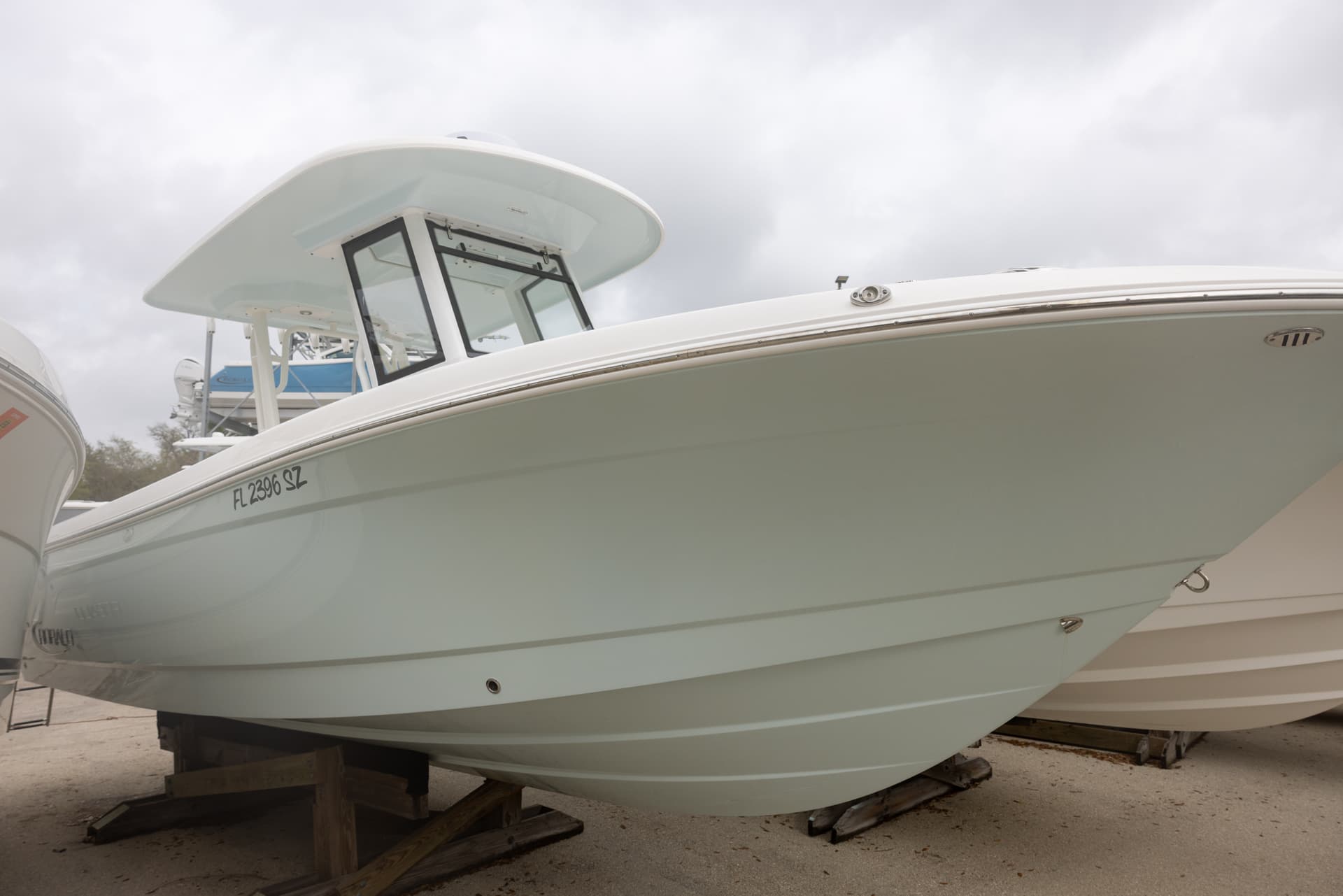
At Fish Tale Boats, we carry Grady-White and Robalo center consoles — two brands engineered specifically for serious offshore work. Grady-White's SeaV² hull is legendary for its soft, dry ride in Gulf chop, while Robalo delivers tournament-grade fishability at an accessible price point. We are proud to be the #1 Robalo dealer worldwide for seven consecutive years.
Dual Consoles: Offshore Comfort
If your offshore days also include family cruising, a dual console like the Grady-White Freedom series gives you a protected helm area, a head compartment, and all the fishing features you need. It is a true crossover — serious enough for a day at the grouper holes, comfortable enough for a sunset cruise to Cabbage Key.
What Size Do You Need?
- 20–24 feet: Near shore, calm-day mid range. Budget-friendly entry.
- 25–30 feet: Handles mid-range comfortably, can make deep runs on good-weather windows.
- 31–36+ feet: True deep-water capability. Extended range, bigger seas, more crew and gear.
Safety: Respecting the Gulf
Offshore fishing in the Gulf demands respect. Unlike inshore waters, you are far from help if something goes wrong.
- File a float plan with someone onshore — where you are going, when you expect to return.
- Check the forecast the night before and morning of. Pay attention to wind speed, wave height, and thunderstorm probability.
- Carry safety gear: EPIRBs or PLBs, VHF radio (and know how to use Channel 16), flares, fire extinguisher, first-aid kit, and enough PFDs for everyone aboard.
- Know your fuel math: The rule of thirds — one-third out, one-third back, one-third reserve.
- Maintain your boat: Engines, bilge pumps, batteries, and through-hulls should be inspected regularly. Our service center in Fort Myers can keep you sea-ready year-round.
Launch Points and Passes
Southwest Florida offers several routes to the Gulf:
- Matanzas Pass (Fort Myers Beach): The most direct shot from Fish Tale's Fort Myers headquarters. Quick access to near-shore reefs.
- New Pass (Bonita Springs): Close to our Bonita Bay Marina location. Shorter run to some productive mid-range spots.
- Gordon Pass (Naples): Excellent access to the Ten Thousand Islands region and the deeper reefs south.
- Boca Grande Pass: World-famous for tarpon, but also a great starting point for offshore runs to the north.
Ready to Get Offshore?
Whether you are rigging your first offshore boat or upgrading to a bigger platform, our team at Fish Tale Boats has decades of experience matching anglers with the right vessel for SWFL waters. Stop by any of our three locations in Fort Myers, Bonita Springs, or Naples to see our current inventory, or contact us to talk through what you need.
Tight lines.